





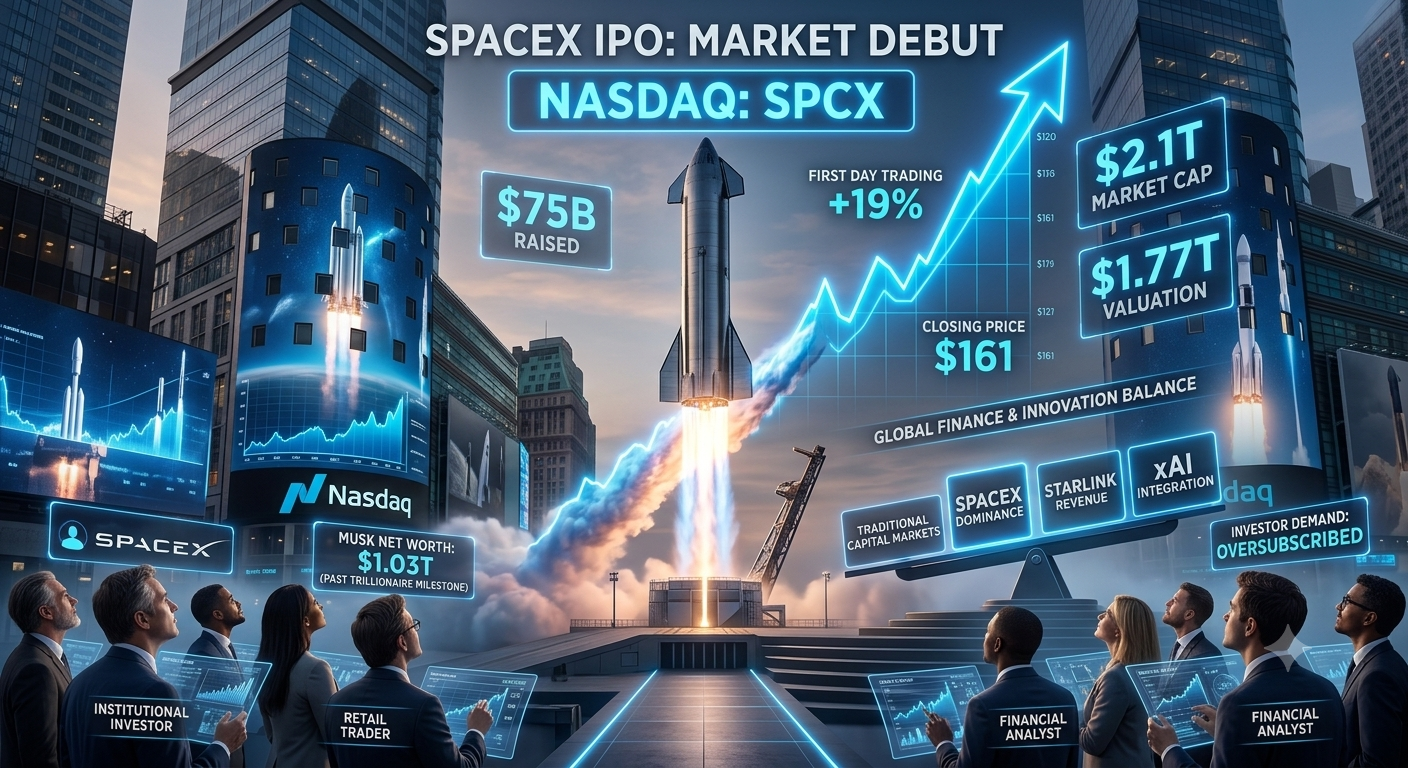
For decades, SpaceX remained one of the world's most valuable privately held companies, consistently reshaping industries ranging from commercial spaceflight to satellite communications. Investors around the globe speculated about a potential public listing, viewing it as one of the most anticipated financial events in modern history. If SpaceX were to enter the public markets, the offering would not simply represent another Initial Public Offering (IPO); it would redefine the scale of global capital markets and establish a completely new benchmark for corporate valuations.
A future SpaceX IPO would symbolize far more than the transition from a private company to a publicly traded enterprise. It would represent the coming together of multiple transformational industries—including aerospace, artificial intelligence, satellite communications, advanced manufacturing, and next-generation transportation—under a single corporate structure. Such an event would likely become one of the defining financial moments of the 21st century, attracting unprecedented attention from governments, institutional investors, retail traders, and technology leaders across the globe.
The anticipation surrounding such a public offering would stem from SpaceX's extraordinary growth over the past two decades. Unlike traditional aerospace companies that primarily manufacture rockets or satellites, SpaceX has developed an integrated ecosystem that combines reusable launch vehicles, satellite broadband infrastructure, deep-space transportation, and increasingly sophisticated artificial intelligence capabilities. Investors would therefore not be purchasing shares in a conventional aerospace company but in an organization positioned at the center of several of the world's fastest-growing industries.
Should SpaceX eventually list on a major stock exchange such as Nasdaq or the New York Stock Exchange, analysts believe investor demand could exceed anything previously witnessed in financial history. Pension funds, sovereign wealth funds, mutual funds, technology-focused investment firms, and millions of retail investors would likely compete aggressively to secure allocations during the IPO process. Such overwhelming demand could easily make the listing the largest public offering ever completed, surpassing previous records established by global technology giants.
The excitement surrounding a SpaceX IPO would not be driven solely by the company's financial performance. Instead, investors would be attracted by the organization's long-term vision of building an interconnected space economy. Unlike many publicly traded corporations that focus primarily on quarterly earnings, SpaceX has consistently invested in projects designed to generate value over decades. This long-term approach has helped establish the company as one of the most innovative organizations in modern industrial history.
One of the strongest pillars supporting investor confidence would undoubtedly be Starlink, the company's rapidly expanding satellite internet network. Over recent years, satellite broadband has evolved from a niche communication service into critical global infrastructure. Millions of residential customers, businesses, airlines, maritime operators, emergency response agencies, and governments increasingly rely on low-Earth-orbit satellite connectivity to maintain reliable internet access regardless of geographical limitations. As subscriber numbers continue growing worldwide, Starlink has the potential to generate recurring revenue on a scale comparable to the largest telecommunications companies in existence.
Beyond internet connectivity, SpaceX's launch services would continue serving as another major engine of long-term growth. Through the successful development of reusable rocket technology, the company dramatically reduced launch costs while simultaneously increasing launch frequency. This technological breakthrough transformed commercial access to space by allowing rockets to be reused multiple times instead of being discarded after a single mission. The resulting reduction in operational costs fundamentally altered the economics of the global launch industry and established SpaceX as the dominant commercial launch provider.
Future investment would also accelerate the development of Starship, the fully reusable heavy-lift launch system designed to carry significantly larger payloads into orbit while dramatically lowering transportation costs. If successfully commercialized at scale, Starship could enable entirely new industries ranging from large-scale orbital manufacturing to lunar infrastructure development and eventually human missions to Mars. Investors would likely view these projects as long-term growth opportunities capable of generating entirely new revenue streams over the coming decades.
Artificial intelligence would likely become another defining component of SpaceX's future business strategy. As satellite constellations continue expanding into the tens of thousands, managing orbital traffic, optimizing communication networks, analyzing Earth observation data, and coordinating autonomous spacecraft would increasingly depend upon advanced AI systems. Integrating artificial intelligence directly into satellite operations would improve efficiency, reduce operational costs, and enhance the performance of global communication infrastructure.
The combination of AI with space-based infrastructure also opens entirely new commercial possibilities. Space-based computing networks, autonomous orbital data centers, intelligent Earth observation platforms, and AI-powered disaster monitoring systems could become major components of future digital infrastructure. Rather than operating as separate industries, aerospace and artificial intelligence are increasingly converging into a single technology ecosystem capable of supporting governments, scientific institutions, and private enterprises alike.
Financial analysts frequently suggest that a future SpaceX IPO would dramatically reshape global investment portfolios. Major stock market indices would almost certainly include the company due to its enormous market capitalization, forcing index funds and exchange-traded funds to purchase billions of dollars worth of shares. This institutional demand alone could significantly increase liquidity while further strengthening SpaceX's position among the world's largest publicly traded corporations.
Retail investors would also play a significant role. Unlike previous technology IPOs that heavily favored institutional buyers, many analysts believe SpaceX could choose to allocate a substantial portion of available shares directly to individual investors. Such an approach would reflect Elon Musk's longstanding interest in encouraging broader public participation in technological innovation while simultaneously creating one of the most widely followed stock listings in financial history.
The successful completion of a SpaceX IPO could also trigger a broader transformation across global capital markets. Other private technology companies specializing in robotics, biotechnology, artificial intelligence, autonomous transportation, advanced manufacturing, and quantum computing might accelerate their own public listing plans after witnessing strong investor appetite for high-growth innovation companies. This domino effect could mark the beginning of a new investment cycle centered around frontier technologies rather than traditional industrial sectors.
The economic impact would extend well beyond financial markets. The enormous capital raised through a public offering could finance additional manufacturing facilities, expanded research laboratories, larger satellite production lines, advanced AI computing infrastructure, and the next generation of launch systems. Thousands of new high-skilled engineering, software development, manufacturing, and research positions could be created as SpaceX continues scaling its global operations.
Governments would also closely monitor such a development. Space infrastructure has increasingly become intertwined with national security, telecommunications, navigation, disaster response, and scientific research. A publicly traded SpaceX with expanded financial resources would further strengthen its influence across multiple strategic industries, making it not only one of the world's largest technology companies but also one of its most significant infrastructure providers.
However, enormous opportunities would naturally be accompanied by equally significant challenges. Public companies operate under strict financial disclosure requirements and face continuous scrutiny from regulators, shareholders, and market analysts. Balancing long-term innovation with quarterly financial expectations would require careful corporate governance to ensure that ambitious research initiatives continue without sacrificing investor confidence.
Despite these challenges, a future SpaceX IPO would represent far more than another successful stock market debut. It would symbolize the growing convergence of aerospace engineering, artificial intelligence, satellite communications, advanced manufacturing, and global digital infrastructure into a unified economic ecosystem. Such a milestone would demonstrate how rapidly humanity's technological priorities are shifting beyond traditional industries toward innovation-driven enterprises capable of reshaping both life on Earth and humanity's future in space.
Ultimately, if SpaceX were ever to become a publicly traded company, the event would likely be remembered as one of the defining moments in financial history. More than simply creating another trillion-dollar corporation, it would represent a new era in which private innovation, public investment, and long-term technological ambition combine to accelerate humanity's progress beyond the limits of previous generations. The success of such an offering would not only influence financial markets but also shape the future direction of space exploration, artificial intelligence, and the global technology economy for decades to come.