







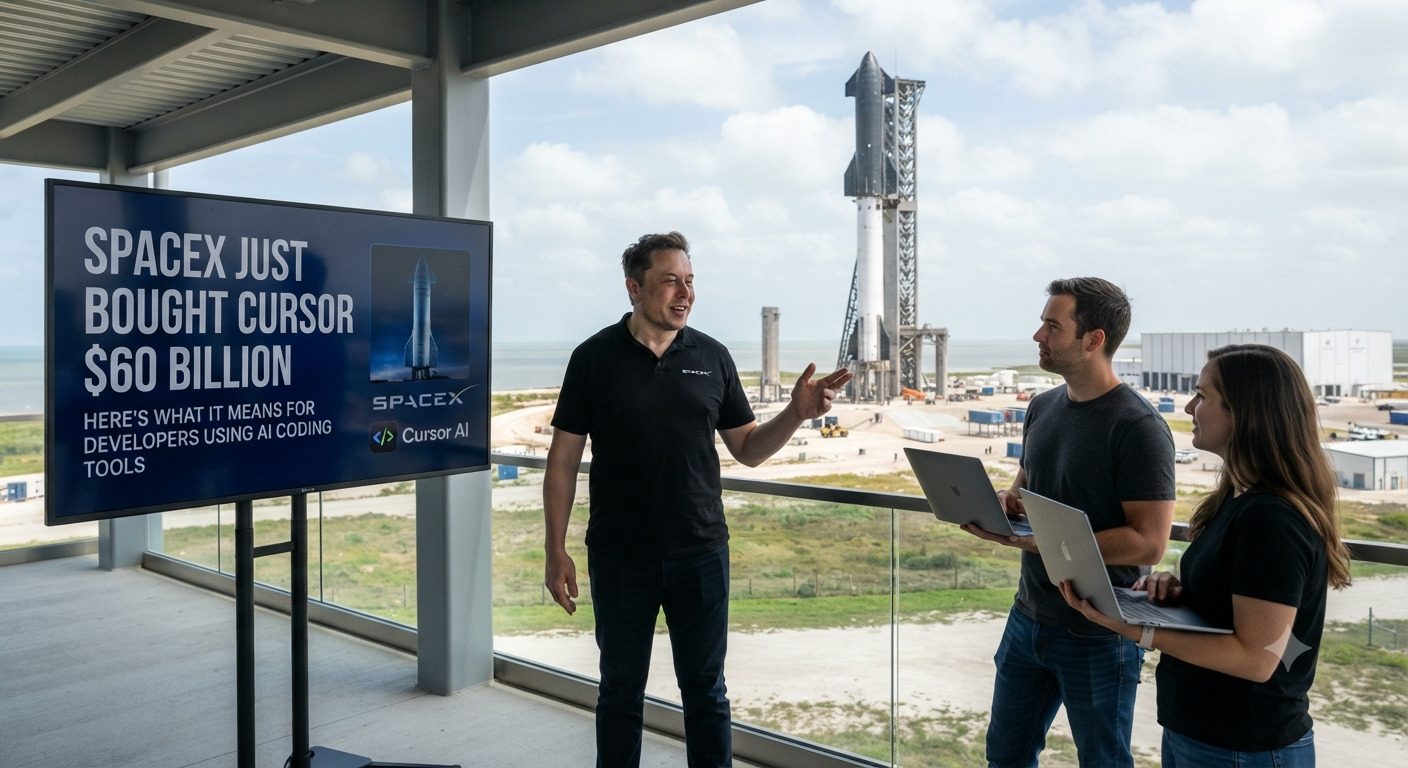
SpaceX Just Bought Cursor for $60 Billion — Here's What It Means for Developers Using AI Coding Tools

SpaceX's surprise acquisition of the AI code editor Cursor has upended the developer tools market almost overnight, with Windsurf shutting down and questions swirling about whether Cursor stays model-agnostic.

SpaceX Just Bought Cursor for $60 Billion — Here's What It Means for Developers Using AI Coding Tools

Quick Summary

In one of the largest acquisitions in developer tooling history, SpaceX bought Cursor, the AI-powered code editor, for a reported $60 billion. The deal arrived just weeks after Cursor was reportedly in talks to raise funding at a $50 billion valuation, and it has already reshaped how developers think about which AI coding tools to trust with long-term projects.

Key Takeaways

  • SpaceX acquired Cursor for approximately $60 billion in July 2026
  • A rival tool, Windsurf, has reportedly shut down entirely amid the shakeup
  • The biggest open question is whether Cursor stays model-agnostic or shifts toward xAI's Grok
  • Most professional developers now use multiple AI coding tools rather than relying on just one

A Deal Nobody Saw Coming

Cursor's growth over the past 18 months has been difficult to overstate. The company reportedly crossed $100 million in annual revenue in January 2025 and passed $2 billion by February 2026 — a pace with little precedent in enterprise software. That momentum made it a natural acquisition target, but few expected the buyer to be SpaceX rather than a traditional software company or cloud provider.

The acquisition instantly made Cursor one of the most valuable developer tools ever sold, and it happened fast enough that a competing raise at a $50 billion valuation was reportedly still in progress when the deal closed.

Why This Matters Beyond the Price Tag

For individual developers, an acquisition of this size raises a practical question that has nothing to do with the money: will the tool they've built their workflow around still work the same way in six months? Cursor built its reputation partly on being model-agnostic — letting developers choose between Claude, GPT, and Gemini inside the same editor. Whether that continues under a new owner, particularly one connected to xAI's Grok models, is the detail teams are watching most closely.

The Ripple Effect: Windsurf's Shutdown

The reshuffling hasn't been limited to Cursor. Windsurf, a competing AI code editor, has reportedly ceased to exist amid the broader consolidation in the space this year. It's a reminder of how quickly the AI coding tools market is consolidating — a crowded field of a dozen serious competitors just two years ago has narrowed considerably.

What Developers Are Actually Doing About It

Rather than betting on a single tool, survey data suggests the majority of professional developers now run three or more AI coding tools side by side — one for in-editor completions, one for architecture and debugging, and one for background or automated tasks. That pattern is likely to become more common, not less, as developers hedge against any single vendor's roadmap changing after an acquisition like this one.

The Practical Takeaway

If you're currently building your workflow around Cursor, there's no reason to switch immediately — the product itself hasn't changed. But it's a reasonable moment to make sure your team isn't fully dependent on one tool's specific model access, given how quickly ownership and priorities can shift in this market right now.

FAQ

Q: How much did SpaceX pay for Cursor?
SpaceX's acquisition of Cursor was reported at approximately $60 billion in July 2026.

Q: Is Cursor still available to use after the acquisition?
Yes, Cursor continues to operate as a product; the acquisition has not resulted in a shutdown or feature removal.

Q: What happened to Windsurf?
Windsurf, a competing AI code editor, has reportedly shut down amid the broader consolidation of the AI coding tools market in 2026.

Q: Will Cursor still support multiple AI models like Claude and GPT?
This remains an open question following the acquisition, and it's one of the most closely watched details among developers currently using the tool.
Quick Summary

SpaceX's surprise acquisition of the AI code editor Cursor has upended the developer tools market almost overnight, with Windsurf shutting down and questions swirling about whether Cursor stays model-agnostic.

Key Takeaways

  • SpaceX acquired Cursor for approximately $60 billion in July 2026
  • A rival tool, Windsurf, has reportedly shut down entirely amid the shakeup
  • The biggest open question is whether Cursor stays model-agnostic or shifts toward xAI's Grok
  • Most professional developers now use multiple AI coding tools rather than relying on just one

Quick Facts

Category: Technology
Published: July 24, 2026
Updated: October 8, 2026
Reading time: 3 min
51 views
Updated Oct 8, 2026 3 min read

Related Articles

View all
The 2026 Smartphone Divide: iPhone vs. Android Technology
News Technology

The 2026 Smartphone Divide: iPhone vs. Android

As we move through 2026, the long-standing rivalry between iOS and Android has evolved. While both platforms are more capable and secure than ever, they serve fundamentally different philosophies: Apple’s curated ecosystem versus Android’s open-source flexibility.

Orwell, George 9 min 293

Popular

View all

Mixed Content

Technology
News Technology

The Post-Automation Economy: Architecting Human Skill Premiums in the Age of Autonomy

The rapid proliferation of agentic workflows and large action models is structurally inverting the traditional corporate skill pyramid. While routine analytical processes and information retrieval tasks are being automated into low-cost utility, uncommoditizable human traits—emotional intelligence, strategic ambiguity management, and ethical governance—are commanding an unprecedented value premium. Succeeding in the post-automation enterprise requires re-engineering workforce development to focu

Mutwassim 3 min 72
The Decline of Friction: Inside the FinTech Revolution in Cross-Border Settlement and Digital Identity Technology
News Technology

The Decline of Friction: Inside the FinTech Revolution in Cross-Border Settlement and Digital Identity

The traditional plumbing of global finance—characterized by multi-day delays, hidden fees, and fragmented identity silo—is undergoing a profound transformation. A new generation of FinTech architectures, combining distributed ledger technology (DLT), synchronized liquidity pools, and decentralized digital passports, is enabling cross-border instant payments with near-zero friction.

Mutwassim 1 min 44
The City as a Switch: Architecting IoT Logistics for the Post-Congestion Urban Era Technology
News Technology

The City as a Switch: Architecting IoT Logistics for the Post-Congestion Urban Era

The traditional model of urban delivery—reliant on high-emission diesel vans navigating static street grids—is creating unsustainable levels of congestion and pollution in global metros. To reclaim urban space, cities are transitioning to IoT-orchestrated logistics. This data-driven framework utilizes autonomous delivery swarms, automated micro-fulfillment centers, and dynamic digital kerb-side management to route goods with the efficiency of internet packets, transforming static streets into fl

Mutwassim 4 min 71
Beyond the Coffee Shop: How Cross-Border Employment and Sovereign Visas Are Institutionalizing Remote Work Technology
News Technology

Beyond the Coffee Shop: How Cross-Border Employment and Sovereign Visas Are Institutionalizing Remote Work

Remote work is transitioning from an informal perk into an institutionalized pillar of international commerce. Over 60 nations have launched dedicated digital nomad visa regimes, while multi-jurisdictional compliance platforms and Employer of Record (EOR) frameworks dismantle traditional geographic barriers. As knowledge workers disperse globally, enterprises and municipal governments are formalizing policies around tax residency, permanent establishment risk, and asynchronous operational workfl

Mutwassim 3 min 71
The Death of Syntax: Inside the Shift to Intent-Driven Software Engineering Technology
News Technology

The Death of Syntax: Inside the Shift to Intent-Driven Software Engineering

The day-to-day discipline of software engineering is undergoing its most radical abstraction leap since the transition from assembly language to high-level compilers. Generative code synthesis and deterministic reasoning engines are automating boilerplate syntax, turning software developers into systems architects. Survival in this new paradigm demands mastering intent formalization, specification design, and continuous verification.

Mutwassim 3 min 71
The Post-Visual Threat: Architecting Zero-Trust Defense Against Weaponized Deepfakes Technology
News Technology

The Post-Visual Threat: Architecting Zero-Trust Defense Against Weaponized Deepfakes

The rapid weaponization of real-time voice cloning and synthetic video generation has transformed social engineering from opportunistic phishing into targeted executive identity emulation. High-profile incidents involving multi-million-dollar wire transfers authorized via synthetic video calls prove that sight and sound can no longer authenticate authorization. Securing modern enterprises requires an uncompromising zero-trust identity layer capable of neutralizing synthetic deception.

Mutwassim 3 min 137
Beyond the Battery: How Electric Mobility Is Forcing a Overhaul of the Global Power Grid Technology
News Technology

Beyond the Battery: How Electric Mobility Is Forcing a Overhaul of the Global Power Grid

The global transition toward electric vehicles is no longer constrained primarily by battery chemistry or vehicle range. Instead, the real bottleneck has shifted directly to the electrical grid. As commercial fleets and passenger cars electrify at scale, utilities and city planners are racing to deploy vehicle-to-grid (V2G) bidirectional systems, AI-driven dynamic load balancers, and decentralized microgrid storage to avoid grid failure.

Mutwassim 3 min 58
Cloud 3.0: The Shift Toward Sovereign Data Architectures and Edge Computing Technology
News Technology

Cloud 3.0: The Shift Toward Sovereign Data Architectures and Edge Computing

The architectural assumption that enterprise compute and storage should reside in a handful of centralized hyperscaler data centers is fracturing. Driven by strict cross-border data sovereignty regulations and the demand for millisecond-latency AI inference, global IT leaders are pivoting to Cloud 3.0—a model centered on distributed, locally governed, and hybrid sovereign architectures.

Mutwassim 3 min 61