





For the past half-century, urban planning focused on a single strategy to manage the movement of goods: expand the physical infrastructure. Cities built wider roads, larger loading zones, and massive centralized distribution centers on the periphery. The assumption was that static concrete and asphalt capacity could scale to meet the linear growth of commerce.
That assumption has collapsed under the weight of e-commerce.
The explosion of same-day, last-mile delivery has saturated municipal street grids. Static infrastructure cannot scale infinitely within defined urban boundaries. The resulting congestion, emissions, and noise pollution are untenable. To build the resilient metros of tomorrow, city planners are moving beyond concrete solutions toward a software-defined architecture: IoT-orchestrated urban logistics.
In this new paradigm, the physical city is treated as a "switch," dynamic routing algorithms manage kerb space in real-time, and goods travel via a decentralized web of autonomous pods and decentralized micro-depots.
The Death of the Fixed Loading Zone: Dynamic Kerb Management
The most inefficient asset in a modern city is the static loading zone. A kerb-side spot reserved for deliveries is either empty and wasted or full, forcing delivery drivers to double-park, obstructing traffic lanes.
IoT urban planning implements dynamic kerb management:
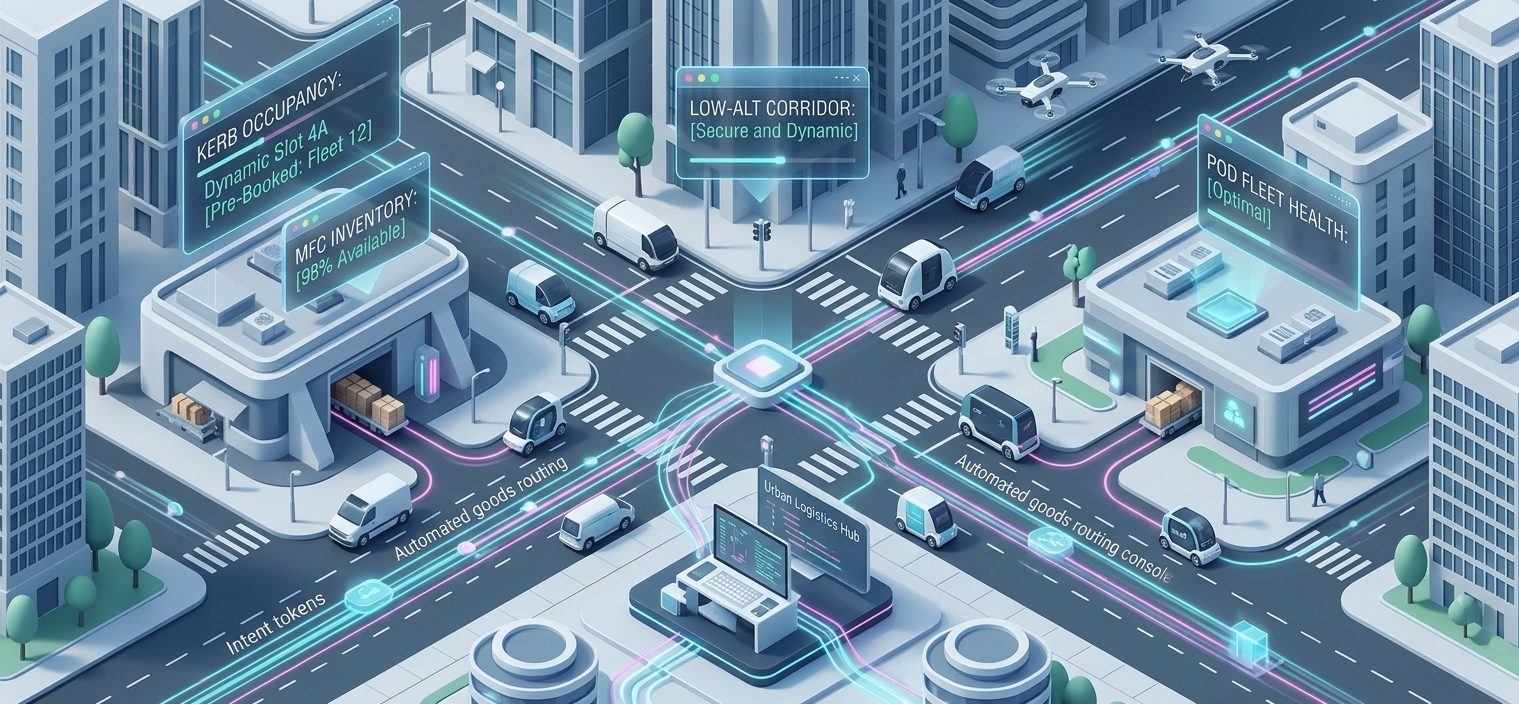
Sensor-Equipped Commercial Bays: Smart pavement sensors and computer vision cameras track occupancy in real-time. Delivery fleets leverage APIs to pre-book loading slots based on their exact arrival window, eliminating idling and search time.
Elastic Street Infrastructure: Municipal control planes dynamically rezone streets throughout the day. A bus lane during rush hour may shift into a multi-modal delivery zone between 10 AM and 3 PM, maximizing asset utility based on data-driven demand profiles.
Usage-Based Geo-Pricing: Cities are deploying geofenced pricing zones for commercial vehicles. Clean, quiet micro-mobility fleets pay low access fees, while high-emission, long-haul trucks are financially incentivized to utilize peripheral transshipment centers during off-peak hours.
Hyper-Localization and the Decoupled Supply Chain
IoT logistics breaks the model of the massive centralized warehouse. The goal is to shrink the last-mile distance from miles to metres.
To achieve this, urban planners are integrating industrial and retail real estate into a decoupled hyper-local supply chain:
Automated Micro-Fulfillment Centers (MFCs): Compact, highly automated picking stations are co-located in repurposed retail basements, disused parking structures, or standardized containers in public squares. These hubs hold high-demand inventory, enabling delivery via foot or bicycle within minutes.
Carrier-Agnostic Parcel Lockers: Modular, network-connected locker banks serve as decentralized micro-depots. They function as final delivery points and efficient consolidation hubs for reverse logistics (returns), reducing home-visit density.
Autonomous Swarms: Drones and Ground-Pods
The final pillar of software-defined logistics is the replacement of human-driven vans with autonomous, electrically-powered micro-mobility swarms.
Last-Metre Aerial Drones: For high-value, time-critical goods like medical supplies or critical components, autonomous drone fleets operate within standardized municipal low-altitude corridors, landing at designated smart-pads or secure MFC rooftops.
Ground-Based Sidewalk Pods: Fleet swarms of compact, slow-moving autonomous ground-pods manage high-volume route optimization. These vehicles, communicating via C-V2X (Cellular Vehicle-to-Everything) protocols with traffic signals and pedestrians, manage standard package deliveries with minimal footprint.
Underground Goods-Pipelines: Pioneering cities are exploring the construction of dedicated utility-tunnel networks for freight. Magnetically levitated automated pods transport cargo silently beneath the street grid, completely bypassing surface-level traffic.
The Municipal IoT Data Fabric
This complex orchestration demands a unified, open-data ecosystem. IoT planning requires standardized APIs where private delivery fleets share real-time location and intent data with municipal control planes. In return, the city provides standardized traffic management, kerb access prioritization, and localized weather and hazard data.
The smart city of the future is not defined by taller skyscrapers, but by its hidden logistics architecture. By prioritizing dynamic digital systems over static concrete infrastructure, urban leaders can reclaim the surface grid for public space while building the most efficient, clean, and quiet goods movement network in history.