





Over the past two decades, enterprise IT underwent two major architectural paradigms. Cloud 1.0 was the era of basic migration—moving legacy on-premise servers into virtualized infrastructure. Cloud 2.0 followed, defined by the consolidation of enterprise workloads into centralized hyperscaler ecosystems, standardizing operations on managed SaaS, PaaS, and serverless architectures.
Today, enterprise engineering is entering Cloud 3.0.
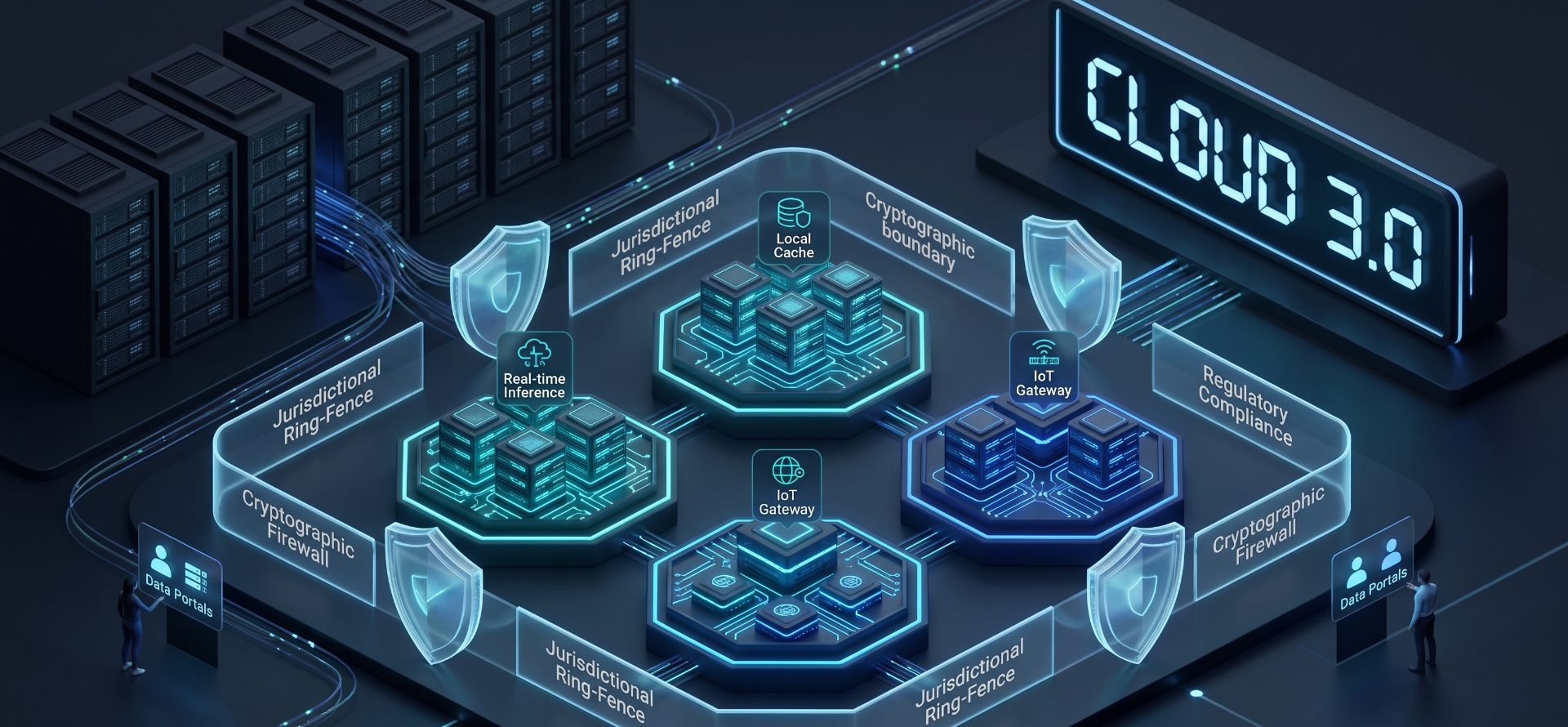
Rather than channeling every byte of enterprise data into a few massive offshore server farms, Cloud 3.0 distributes computation, storage, and orchestration across localized edge environments and legally isolated sovereign frameworks. This transformation is not merely technical—it is driven by an inevitable collision between international data regulations, enterprise risk, and the low-latency demands of real-time AI workloads.
The Regulatory Catalyst: The End of Frictionless Borderless Data
The foundational promise of the early public cloud was borderless elasticity. However, global jurisdictions have made it clear that data is subject to national geography.
From the European Union’s GDPR and NIS2 directives to localized sovereign cloud frameworks across Asia, Latin America, and the Middle East, enterprises face severe penalties if sensitive citizen records, financial data, or operational telematics leave national borders or become accessible to foreign legal warrants.
As a result, the centralized hyperscale model introduces compliance risks that technical firewalls alone cannot resolve. Multinational corporations are forced to re-engineer their systems around data sovereignty:
Jurisdictional Ring-Fencing: Ensuring that encryption keys, metadata, and operational backbones remain strictly within the legal jurisdiction of the host nation.
Zero-Trust Identity Federation: Isolating user credentials and tenant data so cross-border employees only access sanitized, localized application layers.
Vendor-Agnostic Workload Portability: Utilizing lightweight container runtimes and Kubernetes abstractions to ensure enterprise services can rapidly migrate between localized sovereign cloud operators without total platform lock-in.
Real-Time Inference: Moving AI to the Edge
Regulation is only half the equation; the rise of distributed artificial intelligence is driving the other half.
Centralized models are ideal for large-scale training, but running continuous inference on millions of IoT devices, connected autonomous vehicles, and industrial sensors creates unacceptable network latency and bandwidth costs. Shuttling continuous 4K video feeds or industrial telemetry to a centralized cloud data center thousands of miles away introduces network bottlenecks that break mission-critical operations.
Cloud 3.0 solves this by pushing the compute layer directly to the edge:
Local Inference Micro-Clusters: Compact, power-efficient GPU nodes stationed on factory floors, hospital campuses, and regional distribution centers process data at source.
Federated Learning: Machine learning models train across distributed edge nodes locally without ever transmitting raw patient or proprietary enterprise data to an external server. Only cryptographically aggregated model weight updates are sent back to the central architecture.
Split-Stack Deployment: The user-facing application and real-time inference logic execute locally in under 10 milliseconds, while non-urgent asynchronous batch processing and long-term historical analytics remain in regional cloud storage.
Navigating the Operational Overhead of Decentralization
While Cloud 3.0 delivers compliance, privacy, and low-latency execution, it introduces considerable architectural complexity. Managing a fleet of thousands of decentralized edge clusters demands a radical rethink of observability, patch management, and automated orchestration.
To maintain control, enterprise engineering teams are turning to declarative infrastructure-as-code (IaC), unified GitOps deployment pipelines, and centralized multi-cloud control planes. These tools treat a fleet of sovereign nodes as a coherent, unified fabric while honoring the physical and legal boundaries of each location.
The cloud is no longer a monolithic destination where all enterprise software lives. In the Cloud 3.0 paradigm, the cloud is a distributed continuum—stretching from hyperscaler core data centers out to sovereign regional hubs, and ultimately to the intelligent edge.