





The Post-Visual Threat: Architecting Zero-Trust Defense Against Weaponized Deepfakes

As multimodal synthetic media subverts human identity verification, enterprises are stripping visual and acoustic trust from security authorization.

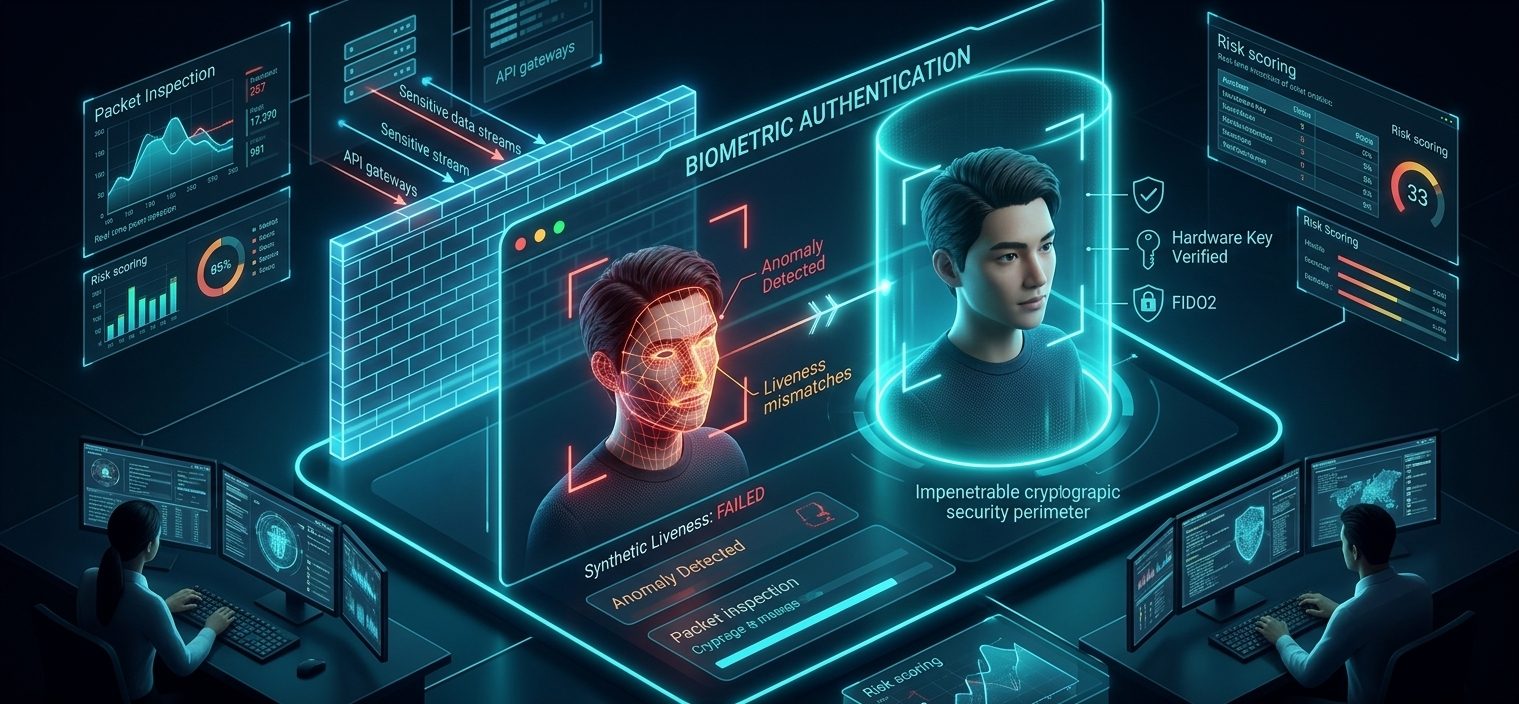
Isometric 3D rendering of a biometric authentication screen scanning a synthetic digital avatar flagged with deepfake anomaly markers.
A conceptual cybersecurity visualization showing real-time AI biometrics detecting facial mesh anomalies in synthetic video streams. Enterprise Cyber Intelligence / Editorial

For decades, enterprise security protocols operated on an implicit psychological assumption: human senses are the ultimate fallback for identity verification. When an automated flag was raised or an unusual transfer requested, security teams relied on direct contact—a phone call to verify voice timbre or a video conference to confirm the executive's physical presence.

That foundational premise is obsolete.

Advances in generative latent diffusion architectures and few-shot voice synthesis have industrialized weaponized deepfakes. Cybercriminals no longer need vast supercomputing clusters to mimic C-suite personnel; 30 seconds of scraped audio from an earnings call and a handful of high-resolution conference photos are sufficient to construct convincing, real-time synthetic avatars.

The battlefield has shifted from endpoint malware protection to an asymmetric war over cognitive trust.

The Anatomy of Modern Identity Emulation

The modern deepfake attack vector diverges sharply from crude consumer face-swapping tools. Today's enterprise incidents leverage real-time multimodal synthesis:

  • Synthetic Video Infiltration: Attackers stage multi-participant video conference rooms where all attendees—save for the target employee—are AI-rendered models mimicking corporate officers, directly pressuring finance personnel to authorize urgent, confidential capital transfers.

  • Acoustic Impersonation via Few-Shot Voice Cloning: Threat actors execute vishing (voice phishing) campaigns using neural text-to-speech engines that adapt instantly to cadence, ambient microphone noise, and linguistic mannerisms, effectively bypassing traditional human voice verification.

  • Contextual Phishing Orchestration: Attackers harvest organizational charts, internal corporate language, and vendor payment schedules via prior supply chain breaches to deploy deepfake communications at peak moments of corporate friction, such as quarterly reporting windows or active M&A transactions.

The Failure of Human Intuition

Relying on staff to "spot the artifact" is an ineffective security policy. While early synthetic media exhibited unnatural eye blinking, blurry edge artifacts, and lighting mismatches, current temporal attention layers and neural rendering engines render artifacts indistinguishable to the human eye—especially through compressed video call streams.

Human detection rates for cutting-edge synthetic media hover barely above pure chance. Treating human perception as a security firewall guarantees breach failure.

The Three Pillars of Deepfake-Resilient Architecture

To defend corporate infrastructure against synthetic identity emulation, Chief Information Security Officers (CISOs) are migrating to a structural Zero-Trust Identity framework:

  1. Deterministic Out-of-Band Verification:

    High-risk actions—such as treasury transfers, master database access, or vendor routing updates—must require cryptographic verification independent of voice or video confirmation. Requests initiated over conference calls must be validated through multi-party approval systems, hardware security keys (FIDO2/WebAuthn), and asynchronous challenge-response protocols that do not rely on audio-visual cues.

  2. Multimodal Synthetic Media Detection Engines:

    Security teams are deploying defensive machine learning models integrated directly into corporate communication gateways (Zoom, Microsoft Teams, Slack). These systems analyze audio-video streams at the packet and sensor level, detecting:

    • Micro-vascular blood flow fluctuations (photoplethysmography) that are absent in synthetic faces.

    • Frame-by-frame temporal jitter and voice acoustic spectral anomalies invisible to human observers.

    • Lighting inconsistencies between the participant’s face geometry and ambient background bounce.

  3. Duress Protocols and Ephemeral Shared Secrets:

    Corporations are institutionalizing shared, offline authentication keys for senior executives and authorized treasury teams. Rotating cryptographic passphrases and strict duress signaling allow employees under suspected deepfake coercion to verify identity without alerting the attacker.

The weaponization of generative media does not represent an isolated cybercrime tactic; it marks the death of passive digital trust. Organizations that survive this transition will be those that treat human sight and sound not as undeniable proof of identity, but as untrusted data streams requiring independent cryptographic verification.

Quick Summary

The rapid weaponization of real-time voice cloning and synthetic video generation has transformed social engineering from opportunistic phishing into targeted executive identity emulation. High-profile incidents involving multi-million-dollar wire transfers authorized via synthetic video calls prove that sight and sound can no longer authenticate authorization. Securing modern enterprises requires an uncompromising z...

Key Takeaways

  • Synthetic Video Infiltration: Attackers stage multi-participant video conference rooms where all attendees—save for the target employee—are AI-rendered models mimicking corporate officers, directly pressuring finance personnel to authorize urgent, confidential capital transfers.
  • Acoustic Impersonation via Few-Shot Voice Cloning: Threat actors execute vishing (voice phishing) campaigns using neural text-to-speech engines that adapt instantly to cadence, ambient microphone noise, and linguistic mannerisms, effectively bypassing traditional human voice verification.
  • Contextual Phishing Orchestration: Attackers harvest organizational charts, internal corporate language, and vendor payment schedules via prior supply chain breaches to deploy deepfake communications at peak moments of corporate friction, such as quarterly reporting windows or active M&A transactions.
  • Deterministic Out-of-Band Verification:High-risk actions—such as treasury transfers, master database access, or vendor routing updates—must require cryptographic verification independent of voice or video confirmation. Requests initiated over conference calls must be validated through multi-party approval systems, hardware security keys (FIDO2/WebAuthn), and asynchronous challenge-response protocols that do not rely on audio-visual cues.
  • Multimodal Synthetic Media Detection Engines:Security teams are deploying defensive machine learning models integrated directly into corporate communication gateways (Zoom, Microsoft Teams, Slack). These systems analyze audio-video streams at the packet and sensor level, detecting:Micro-vascular blood flow fluctuations (photoplethysmography) that are absent in synthetic faces.

Quick Facts

Category: Technology
Published: September 4, 2026
Updated: October 10, 2026
Reading time: 3 min
139 views
Updated Oct 10, 2026 3 min read

Related Articles

View all
The 2026 Smartphone Divide: iPhone vs. Android Technology
Article Technology

The 2026 Smartphone Divide: iPhone vs. Android

As we move through 2026, the long-standing rivalry between iOS and Android has evolved. While both platforms are more capable and secure than ever, they serve fundamentally different philosophies: Apple’s curated ecosystem versus Android’s open-source flexibility.

Orwell, George 9 min 293

Mixed Content

Technology
Article Technology

The Post-Automation Economy: Architecting Human Skill Premiums in the Age of Autonomy

The rapid proliferation of agentic workflows and large action models is structurally inverting the traditional corporate skill pyramid. While routine analytical processes and information retrieval tasks are being automated into low-cost utility, uncommoditizable human traits—emotional intelligence, strategic ambiguity management, and ethical governance—are commanding an unprecedented value premium. Succeeding in the post-automation enterprise requires re-engineering workforce development to focu

Mutwassim 3 min 72
The Decline of Friction: Inside the FinTech Revolution in Cross-Border Settlement and Digital Identity Technology
Article Technology

The Decline of Friction: Inside the FinTech Revolution in Cross-Border Settlement and Digital Identity

The traditional plumbing of global finance—characterized by multi-day delays, hidden fees, and fragmented identity silo—is undergoing a profound transformation. A new generation of FinTech architectures, combining distributed ledger technology (DLT), synchronized liquidity pools, and decentralized digital passports, is enabling cross-border instant payments with near-zero friction.

Mutwassim 1 min 44
The City as a Switch: Architecting IoT Logistics for the Post-Congestion Urban Era Technology
Article Technology

The City as a Switch: Architecting IoT Logistics for the Post-Congestion Urban Era

The traditional model of urban delivery—reliant on high-emission diesel vans navigating static street grids—is creating unsustainable levels of congestion and pollution in global metros. To reclaim urban space, cities are transitioning to IoT-orchestrated logistics. This data-driven framework utilizes autonomous delivery swarms, automated micro-fulfillment centers, and dynamic digital kerb-side management to route goods with the efficiency of internet packets, transforming static streets into fl

Mutwassim 4 min 71
Beyond the Coffee Shop: How Cross-Border Employment and Sovereign Visas Are Institutionalizing Remote Work Technology
Article Technology

Beyond the Coffee Shop: How Cross-Border Employment and Sovereign Visas Are Institutionalizing Remote Work

Remote work is transitioning from an informal perk into an institutionalized pillar of international commerce. Over 60 nations have launched dedicated digital nomad visa regimes, while multi-jurisdictional compliance platforms and Employer of Record (EOR) frameworks dismantle traditional geographic barriers. As knowledge workers disperse globally, enterprises and municipal governments are formalizing policies around tax residency, permanent establishment risk, and asynchronous operational workfl

Mutwassim 3 min 71
The Death of Syntax: Inside the Shift to Intent-Driven Software Engineering Technology
Article Technology

The Death of Syntax: Inside the Shift to Intent-Driven Software Engineering

The day-to-day discipline of software engineering is undergoing its most radical abstraction leap since the transition from assembly language to high-level compilers. Generative code synthesis and deterministic reasoning engines are automating boilerplate syntax, turning software developers into systems architects. Survival in this new paradigm demands mastering intent formalization, specification design, and continuous verification.

Mutwassim 3 min 71
Beyond the Battery: How Electric Mobility Is Forcing a Overhaul of the Global Power Grid Technology
Article Technology

Beyond the Battery: How Electric Mobility Is Forcing a Overhaul of the Global Power Grid

The global transition toward electric vehicles is no longer constrained primarily by battery chemistry or vehicle range. Instead, the real bottleneck has shifted directly to the electrical grid. As commercial fleets and passenger cars electrify at scale, utilities and city planners are racing to deploy vehicle-to-grid (V2G) bidirectional systems, AI-driven dynamic load balancers, and decentralized microgrid storage to avoid grid failure.

Mutwassim 3 min 58
Cloud 3.0: The Shift Toward Sovereign Data Architectures and Edge Computing Technology
Article Technology

Cloud 3.0: The Shift Toward Sovereign Data Architectures and Edge Computing

The architectural assumption that enterprise compute and storage should reside in a handful of centralized hyperscaler data centers is fracturing. Driven by strict cross-border data sovereignty regulations and the demand for millisecond-latency AI inference, global IT leaders are pivoting to Cloud 3.0—a model centered on distributed, locally governed, and hybrid sovereign architectures.

Mutwassim 3 min 61
Beyond Offshoring: The Strategic Pivot to Multi-Hub Sourcing and Nearshore Resilience Technology
Article Technology

Beyond Offshoring: The Strategic Pivot to Multi-Hub Sourcing and Nearshore Resilience

The era of hyper-optimized, single-country manufacturing has come to an end. Faced with regulatory friction, geopolitical realignment, and maritime chokepoint vulnerabilities, global corporations are trading the narrow margins of ultra-lean offshoring for redundant, regionalized production networks. This strategic decoupling is fundamentally rewriting global trade routes and capital expenditure priorities.

Mutwassim 3 min 44