





For more than forty years, the security of the entire digital world has depended on a simple mathematical principle. Every online transaction, banking login, private message, software update, and secure website connection uses public-key encryption. This includes well-known algorithms like RSA and Elliptic Curve Cryptography. These systems work because traditional computers find it easy to verify the encryption keys, but virtually impossible to calculate the private secret backwards within a normal human lifespan.
However, the rise of powerful quantum computers is changing this reality. Unlike standard computers that process data in simple ones and zeros, quantum computers use quantum mechanics to solve massive, complex mathematical problems at unprecedented speeds.
When a sufficiently powerful quantum computer is built, it will be able to break traditional public-key encryption in seconds. This means the encryption protecting our digital infrastructure will no longer be secure.
Many people think this is a problem for the distant future, but security experts know the threat is happening right now. Attackers are already using a strategy known as Harvest Now, Decrypt Later. They intercept and save massive amounts of encrypted data today—such as banking records, intellectual property, medical files, and government communications—with the goal of unlocking and reading that data the moment a quantum computer becomes available.
Because official global standards for post-quantum security are now finalized by bodies like the National Institute of Standards and Technology (NIST), organizations must take immediate action. This means replacing outdated encryption with new quantum-resistant methods and building flexible systems that can easily adapt as security needs evolve.
Why Waiting Is Not an Option: The Real-World Risk
To understand why companies need to act immediately, it helps to look at how long data needs to stay safe versus how long it takes to upgrade large computer systems.
1. The Lifetime of Sensitive Data
A lot of digital information loses its value quickly, but sensitive records must remain confidential for decades. Examples include:
Medical and genetic records that last a person's entire lifetime.
Long-term financial agreements, loans, and banking contracts.
Proprietary corporate research, trade secrets, and patented formulas.
National defense blueprints and critical infrastructure designs.
If this data is intercepted today, it will still be confidential and valuable ten, twenty, or thirty years from now when quantum decryption machines are running.
2. The Time It Takes to Upgrade Enterprise Systems
Upgrading security across a large organization is never as simple as clicking a single update button. Large companies run thousands of servers, internal tools, mobile apps, database systems, and external vendor connections. Finding every place where old encryption keys are hardcoded and safely replacing them often takes three to seven years of steady engineering work.
3. The Harvest Now, Decrypt Later Problem
Cybercriminals and state-sponsored groups are not waiting for quantum hardware to finish development before stealing data. They are tapping internet backbones and collecting petabytes of encrypted traffic right now. They catalog and store this information in massive storage facilities. The day quantum systems go live, these stored archives will be unlocked. If your data is stolen today under old encryption, it is already at risk.
Understanding the New Post-Quantum Encryption Standards
Traditional encryption relies on math problems like factoring huge numbers. The new Post-Quantum Cryptography (PQC) standards rely on completely different mathematical problems that both normal computers and quantum computers find impossible to break.
1. Lattice-Based Encryption
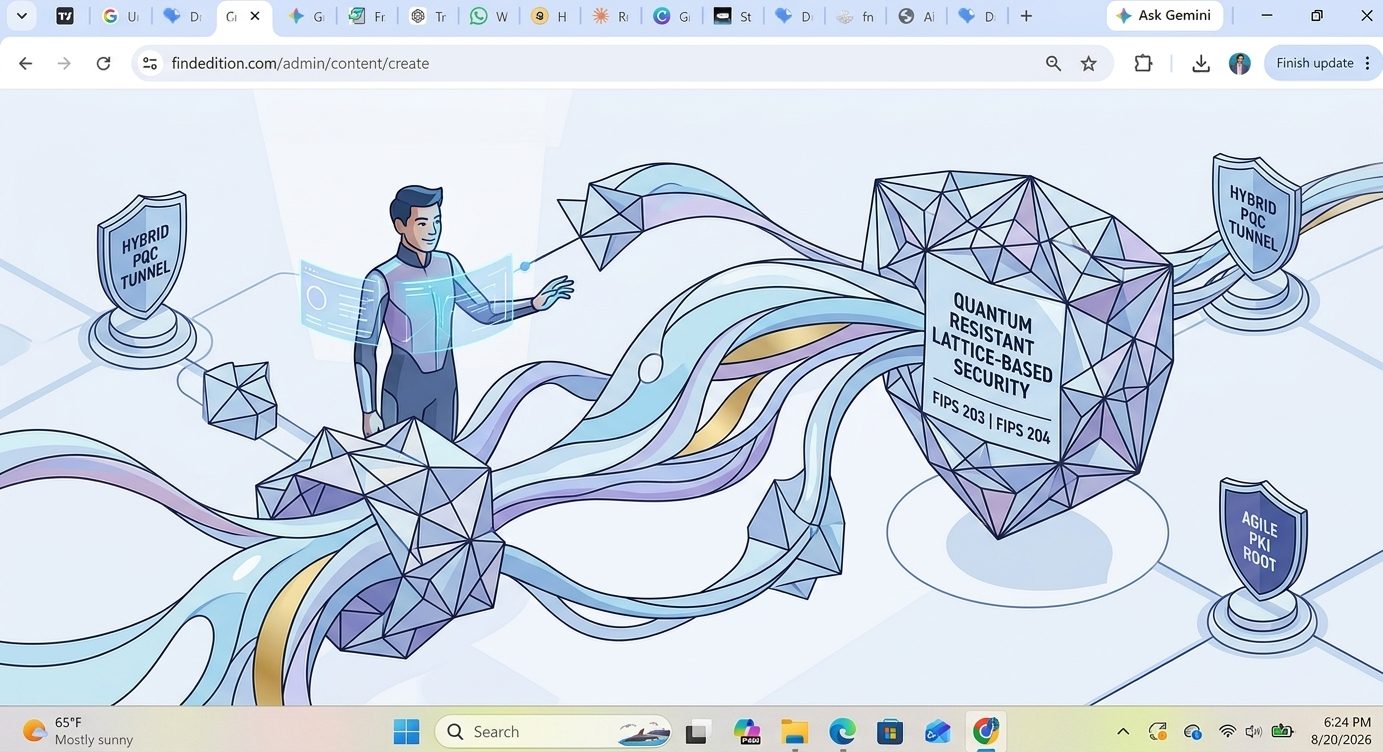
The most important foundation of modern post-quantum security is called lattice-based cryptography. Instead of working with simple numbers, it works with complex, high-dimensional geometric grids (lattices). Calculating the exact points within these multidimensional shapes while filtering out mathematical noise is so complex that quantum computers cannot solve it quickly.
ML-KEM (formerly Kyber): This is the primary standard used to establish secure connections. It replaces traditional key exchanges in websites (HTTPS), secure email, and VPN tunnels.
ML-DSA (formerly Dilithium): This is the main standard used for digital signatures. It proves identity and confirms that a message or website has not been altered.
2. Hash-Based Digital Signatures
Another dependable approach uses cryptographic hash functions, which are already naturally resistant to quantum attacks.
SLH-DSA (formerly SPHINCS+): This standard provides a reliable backup method for creating digital signatures. It is especially useful for securing root certificates, validating operating system boot sequences, and authenticating long-term firmware updates where absolute reliability is critical.
Technical Challenges When Upgrading to Post-Quantum Security
Switching to post-quantum encryption is not an invisible change. The new mathematical algorithms behave differently from older tools, creating specific technical hurdles that software developers and network engineers must handle.
Larger Key and Signature Sizes
Old encryption keys and digital signatures were very small—often less than one hundred bytes. In contrast, post-quantum signatures and keys are much larger, sometimes measuring several kilobytes.
When a web browser connects to a server, sending these larger keys can cause data packets to split into multiple smaller pieces across the network. If older firewalls or routers are not configured properly, they may drop these split packets, slowing down connection speeds or causing connection errors on mobile devices.
Memory Constraints on Smaller Devices
While modern cloud servers have plenty of computing power and memory to handle larger post-quantum calculations, smaller devices like smart home sensors, automotive controllers, and payment terminals have very limited memory. Engineers must carefully optimize software so these small microchips can handle the larger keys without crashing or running out of memory.
The Hybrid Approach: The Safest Path Forward
Organizations cannot simply shut off classical encryption and switch 100% to brand-new algorithms overnight. If a newly developed post-quantum algorithm contains an unexpected bug or vulnerability, a pure post-quantum system could fail. On the other hand, relying only on old algorithms leaves you vulnerable to quantum attacks.
The industry solution is the Hybrid Security Model.
In a hybrid setup, every secure connection creates two keys at the same time:
One key using proven classical encryption (like Elliptic Curve).
A second key using the new post-quantum encryption (like ML-KEM).
The system merges these two keys together to protect the session. An attacker would have to break both the traditional encryption and the new quantum-safe algorithm simultaneously to steal the data. This provides immediate safety against current data harvesting while ensuring that systems remain compliant with existing security rules.
What Is Cryptographic Agility and Why Does It Matter?
In past decades, software developers treated encryption as a "set it and forget it" feature. A team would pick an encryption method, write it directly into their database code, and leave it running untouched for years.
Today, this rigid setup is dangerous. As new security standards arrive and older methods retire, systems must be built with Cryptographic Agility.
Cryptographic agility means designing software so that encryption methods, key sizes, and certificates can be updated, rotated, or replaced through simple configuration settings—without having to rewrite the application from scratch or take down production databases.
Core Principles of an Agile System:
Separation of Logic and Security: Applications should ask for generic security tasks (like "Encrypt Customer Record") rather than hardcoding a specific encryption tool directly into the code.
Flexible Data Headers: When saving encrypted data, include a label in the record showing which algorithm and key version were used. This lets old and new records live side by side without database errors.
Automated Certificate Updates: Use automated systems to replace and rotate digital certificates across your servers in minutes rather than updating them manually by hand.
Step-by-Step Migration Roadmap for Organizations
Moving an organization to quantum-safe security requires a clear, structured plan. Here is how modern technical teams approach the transition:
Step 1: Discover and Inventory (CBOM)
You cannot secure what you do not know you have. The first step is running automated scans across your codebase and networks to create a complete Cryptographic Bill of Materials (CBOM). This catalog identifies every certificate, algorithm, and hardcoded key in use, while sorting data by how long it needs to stay confidential.
Step 2: Secure Public Gateways and Network Tunnels
Protect the traffic that travels across the public internet first, as this is where data harvesting happens:
Upgrade web load balancers and reverse proxies to support hybrid TLS connections.
Upgrade company VPNs and connections between offices and data centers so internal traffic cannot be intercepted.
Step 3: Upgrade Internal Identity and Signatures
Modernize internal authentication:
Update internal Certificate Authorities to issue post-quantum digital signatures.
Secure internal service communications and software deployment pipelines by signing all company software builds with modern signatures.
Step 4: Protect Stored Data and Audit Third-Party Vendors
Address databases and external partners:
Upgrade database encryption routines to support quantum-safe keys.
Require software vendors, cloud providers, and API partners to provide clear timelines for when their services will support post-quantum standards.
Impact Across Key Industries
The post-quantum shift directly affects every major sector of the global economy:
Banking and Financial Services
Financial institutions process trillions of dollars in daily transactions and manage long-term contracts like thirty-year mortgages. If underlying encryption breaks, the security of digital ledgers and transaction histories is compromised. Major banks are already testing hybrid quantum-safe payment systems to protect institutional assets and customer funds.
Healthcare and Genetics
Medical histories and DNA data are permanent. Unlike a password, you cannot reset or change your genetic profile once it has been stolen. Healthcare providers and research labs are prioritizing quantum-safe encryption to protect patient records against future decryption.
Critical Infrastructure and Defense
Power grids, water systems, satellite links, and industrial facilities run on hardware designed to operate for decades without replacement. Equipment installed in remote areas today must have post-quantum defenses built in from the start so it does not become vulnerable midway through its operating life.
Common Misconceptions to Avoid
When preparing for post-quantum security, teams often run into a few common misunderstandings:
Misconception 1: "We must replace AES encryption."
This is incorrect. Standard AES-256 symmetric encryption remains completely safe against quantum computers. Post-quantum upgrades focus on replacing asymmetric public-key systems (like RSA and ECC), which are the tools used for key exchanges and digital signatures.
Misconception 2: "This is just a one-time software patch."
Upgrading to post-quantum security is an ongoing operational practice, not a one-time project. Standards will continue to refine, and maintaining flexible systems will be an ongoing priority.
Misconception 3: "Testing on local networks is enough."
Because post-quantum keys are larger, they must be tested on real-world networks with mobile devices and variable signal strengths to make sure latency and connection speeds remain smooth for end users.
Summary
The quantum era is bringing exciting technological breakthroughs, but it also demands a fundamental upgrade to the way we protect digital data. Waiting for quantum computers to arrive before updating security systems leaves sensitive records exposed to ongoing data harvesting.
By conducting clear security audits, deploying hybrid encryption on network borders, and building software that can easily adapt to new algorithms, organizations can safeguard their systems, protect user trust, and build a resilient foundation for the decades ahead.