






Cloud 3.0: The Shift Toward Sovereign Data Architectures and Edge Computing

Stricter regulatory boundaries, data residency laws, and edge AI inferencing are unraveling the era of monolithic public clouds.

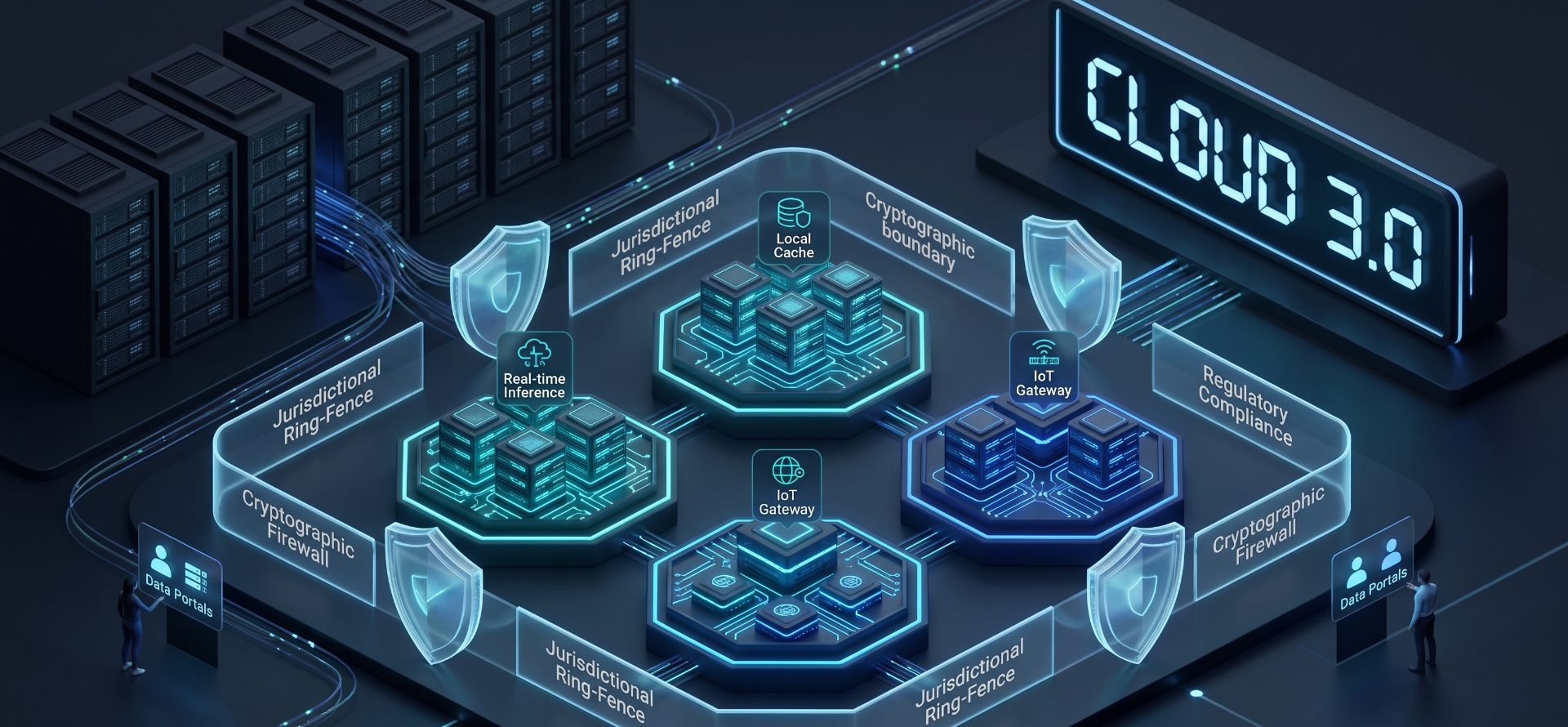
Isometric 3D rendering of interconnected edge data centers protected by regional cryptographic firewall boundaries.
A conceptual network diagram illustrating decentralized, localized edge server clusters operating under sovereign security perimeters. Enterprise Tech Archive / Editorial

Over the past two decades, enterprise IT underwent two major architectural paradigms. Cloud 1.0 was the era of basic migration—moving legacy on-premise servers into virtualized infrastructure. Cloud 2.0 followed, defined by the consolidation of enterprise workloads into centralized hyperscaler ecosystems, standardizing operations on managed SaaS, PaaS, and serverless architectures.

Today, enterprise engineering is entering Cloud 3.0.

Rather than channeling every byte of enterprise data into a few massive offshore server farms, Cloud 3.0 distributes computation, storage, and orchestration across localized edge environments and legally isolated sovereign frameworks. This transformation is not merely technical—it is driven by an inevitable collision between international data regulations, enterprise risk, and the low-latency demands of real-time AI workloads.

The Regulatory Catalyst: The End of Frictionless Borderless Data

The foundational promise of the early public cloud was borderless elasticity. However, global jurisdictions have made it clear that data is subject to national geography.

From the European Union’s GDPR and NIS2 directives to localized sovereign cloud frameworks across Asia, Latin America, and the Middle East, enterprises face severe penalties if sensitive citizen records, financial data, or operational telematics leave national borders or become accessible to foreign legal warrants.

As a result, the centralized hyperscale model introduces compliance risks that technical firewalls alone cannot resolve. Multinational corporations are forced to re-engineer their systems around data sovereignty:

  • Jurisdictional Ring-Fencing: Ensuring that encryption keys, metadata, and operational backbones remain strictly within the legal jurisdiction of the host nation.

  • Zero-Trust Identity Federation: Isolating user credentials and tenant data so cross-border employees only access sanitized, localized application layers.

  • Vendor-Agnostic Workload Portability: Utilizing lightweight container runtimes and Kubernetes abstractions to ensure enterprise services can rapidly migrate between localized sovereign cloud operators without total platform lock-in.

Real-Time Inference: Moving AI to the Edge

Regulation is only half the equation; the rise of distributed artificial intelligence is driving the other half.

Centralized models are ideal for large-scale training, but running continuous inference on millions of IoT devices, connected autonomous vehicles, and industrial sensors creates unacceptable network latency and bandwidth costs. Shuttling continuous 4K video feeds or industrial telemetry to a centralized cloud data center thousands of miles away introduces network bottlenecks that break mission-critical operations.

Cloud 3.0 solves this by pushing the compute layer directly to the edge:

  • Local Inference Micro-Clusters: Compact, power-efficient GPU nodes stationed on factory floors, hospital campuses, and regional distribution centers process data at source.

  • Federated Learning: Machine learning models train across distributed edge nodes locally without ever transmitting raw patient or proprietary enterprise data to an external server. Only cryptographically aggregated model weight updates are sent back to the central architecture.

  • Split-Stack Deployment: The user-facing application and real-time inference logic execute locally in under 10 milliseconds, while non-urgent asynchronous batch processing and long-term historical analytics remain in regional cloud storage.

Navigating the Operational Overhead of Decentralization

While Cloud 3.0 delivers compliance, privacy, and low-latency execution, it introduces considerable architectural complexity. Managing a fleet of thousands of decentralized edge clusters demands a radical rethink of observability, patch management, and automated orchestration.

To maintain control, enterprise engineering teams are turning to declarative infrastructure-as-code (IaC), unified GitOps deployment pipelines, and centralized multi-cloud control planes. These tools treat a fleet of sovereign nodes as a coherent, unified fabric while honoring the physical and legal boundaries of each location.

The cloud is no longer a monolithic destination where all enterprise software lives. In the Cloud 3.0 paradigm, the cloud is a distributed continuum—stretching from hyperscaler core data centers out to sovereign regional hubs, and ultimately to the intelligent edge.


Quick Summary

The architectural assumption that enterprise compute and storage should reside in a handful of centralized hyperscaler data centers is fracturing. Driven by strict cross-border data sovereignty regulations and the demand for millisecond-latency AI inference, global IT leaders are pivoting to Cloud 3.0—a model centered on distributed, locally governed, and hybrid sovereign architectures.

Key Takeaways

  • Jurisdictional Ring-Fencing: Ensuring that encryption keys, metadata, and operational backbones remain strictly within the legal jurisdiction of the host nation.
  • Zero-Trust Identity Federation: Isolating user credentials and tenant data so cross-border employees only access sanitized, localized application layers.
  • Vendor-Agnostic Workload Portability: Utilizing lightweight container runtimes and Kubernetes abstractions to ensure enterprise services can rapidly migrate between localized sovereign cloud operators without total platform lock-in.
  • Local Inference Micro-Clusters: Compact, power-efficient GPU nodes stationed on factory floors, hospital campuses, and regional distribution centers process data at source.
  • Federated Learning: Machine learning models train across distributed edge nodes locally without ever transmitting raw patient or proprietary enterprise data to an external server. Only cryptographically aggregated model weight updates are sent back to the central architecture.

Quick Facts

Category: Technology
Published: September 4, 2026
Updated: October 8, 2026
Reading time: 3 min
61 views
Updated Oct 8, 2026 3 min read

Related Articles

View all
The 2026 Smartphone Divide: iPhone vs. Android Technology
Article Technology

The 2026 Smartphone Divide: iPhone vs. Android

As we move through 2026, the long-standing rivalry between iOS and Android has evolved. While both platforms are more capable and secure than ever, they serve fundamentally different philosophies: Apple’s curated ecosystem versus Android’s open-source flexibility.

Orwell, George 9 min 293

Mixed Content

Technology
Article Technology

The Post-Automation Economy: Architecting Human Skill Premiums in the Age of Autonomy

The rapid proliferation of agentic workflows and large action models is structurally inverting the traditional corporate skill pyramid. While routine analytical processes and information retrieval tasks are being automated into low-cost utility, uncommoditizable human traits—emotional intelligence, strategic ambiguity management, and ethical governance—are commanding an unprecedented value premium. Succeeding in the post-automation enterprise requires re-engineering workforce development to focu

Mutwassim 3 min 72
The Decline of Friction: Inside the FinTech Revolution in Cross-Border Settlement and Digital Identity Technology
Article Technology

The Decline of Friction: Inside the FinTech Revolution in Cross-Border Settlement and Digital Identity

The traditional plumbing of global finance—characterized by multi-day delays, hidden fees, and fragmented identity silo—is undergoing a profound transformation. A new generation of FinTech architectures, combining distributed ledger technology (DLT), synchronized liquidity pools, and decentralized digital passports, is enabling cross-border instant payments with near-zero friction.

Mutwassim 1 min 44
The City as a Switch: Architecting IoT Logistics for the Post-Congestion Urban Era Technology
Article Technology

The City as a Switch: Architecting IoT Logistics for the Post-Congestion Urban Era

The traditional model of urban delivery—reliant on high-emission diesel vans navigating static street grids—is creating unsustainable levels of congestion and pollution in global metros. To reclaim urban space, cities are transitioning to IoT-orchestrated logistics. This data-driven framework utilizes autonomous delivery swarms, automated micro-fulfillment centers, and dynamic digital kerb-side management to route goods with the efficiency of internet packets, transforming static streets into fl

Mutwassim 4 min 71
Beyond the Coffee Shop: How Cross-Border Employment and Sovereign Visas Are Institutionalizing Remote Work Technology
Article Technology

Beyond the Coffee Shop: How Cross-Border Employment and Sovereign Visas Are Institutionalizing Remote Work

Remote work is transitioning from an informal perk into an institutionalized pillar of international commerce. Over 60 nations have launched dedicated digital nomad visa regimes, while multi-jurisdictional compliance platforms and Employer of Record (EOR) frameworks dismantle traditional geographic barriers. As knowledge workers disperse globally, enterprises and municipal governments are formalizing policies around tax residency, permanent establishment risk, and asynchronous operational workfl

Mutwassim 3 min 71
The Death of Syntax: Inside the Shift to Intent-Driven Software Engineering Technology
Article Technology

The Death of Syntax: Inside the Shift to Intent-Driven Software Engineering

The day-to-day discipline of software engineering is undergoing its most radical abstraction leap since the transition from assembly language to high-level compilers. Generative code synthesis and deterministic reasoning engines are automating boilerplate syntax, turning software developers into systems architects. Survival in this new paradigm demands mastering intent formalization, specification design, and continuous verification.

Mutwassim 3 min 71
The Post-Visual Threat: Architecting Zero-Trust Defense Against Weaponized Deepfakes Technology
Article Technology

The Post-Visual Threat: Architecting Zero-Trust Defense Against Weaponized Deepfakes

The rapid weaponization of real-time voice cloning and synthetic video generation has transformed social engineering from opportunistic phishing into targeted executive identity emulation. High-profile incidents involving multi-million-dollar wire transfers authorized via synthetic video calls prove that sight and sound can no longer authenticate authorization. Securing modern enterprises requires an uncompromising zero-trust identity layer capable of neutralizing synthetic deception.

Mutwassim 3 min 139
Beyond the Battery: How Electric Mobility Is Forcing a Overhaul of the Global Power Grid Technology
Article Technology

Beyond the Battery: How Electric Mobility Is Forcing a Overhaul of the Global Power Grid

The global transition toward electric vehicles is no longer constrained primarily by battery chemistry or vehicle range. Instead, the real bottleneck has shifted directly to the electrical grid. As commercial fleets and passenger cars electrify at scale, utilities and city planners are racing to deploy vehicle-to-grid (V2G) bidirectional systems, AI-driven dynamic load balancers, and decentralized microgrid storage to avoid grid failure.

Mutwassim 3 min 58
Beyond Offshoring: The Strategic Pivot to Multi-Hub Sourcing and Nearshore Resilience Technology
Article Technology

Beyond Offshoring: The Strategic Pivot to Multi-Hub Sourcing and Nearshore Resilience

The era of hyper-optimized, single-country manufacturing has come to an end. Faced with regulatory friction, geopolitical realignment, and maritime chokepoint vulnerabilities, global corporations are trading the narrow margins of ultra-lean offshoring for redundant, regionalized production networks. This strategic decoupling is fundamentally rewriting global trade routes and capital expenditure priorities.

Mutwassim 3 min 44