





The idea of using ChatGPT as a simple chatbot is becoming outdated.
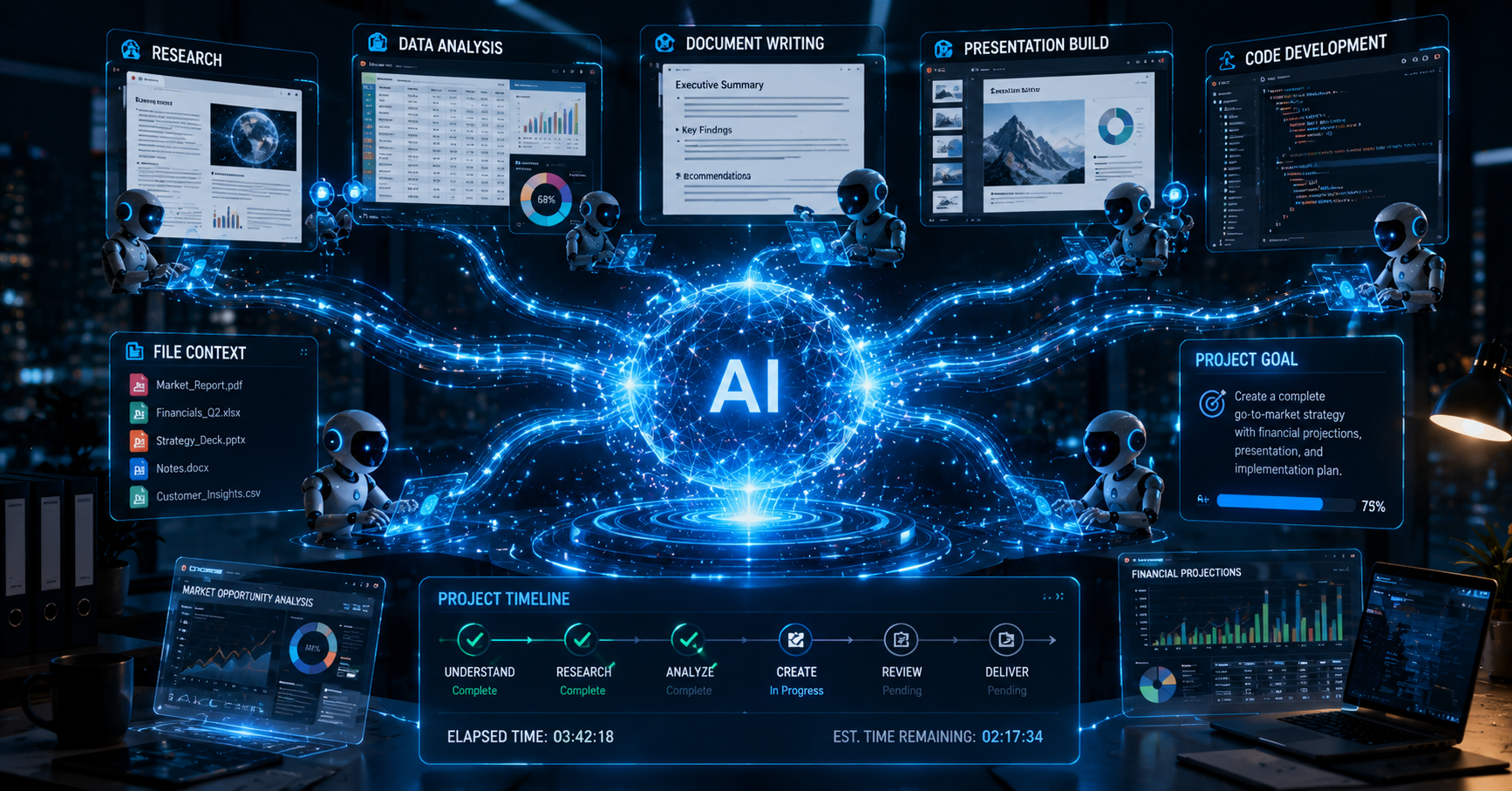
OpenAI has launched GPT-5.6 alongside ChatGPT Work, a new AI agent designed to stay with complex projects, interact with connected tools and turn broad goals into finished outputs.
This is a major change in how OpenAI wants people to think about artificial intelligence.
Instead of asking AI one question at a time, users can increasingly give it a larger objective.
The system can then work through multiple steps.
Research information.
Use available files.
Interact with connected tools.
Create documents.
Build presentations.
Analyse information.
And continue working on a project for hours when necessary.
The AI race is moving from chatbots that answer questions to agents that attempt to complete work.
ChatGPT Is Moving Beyond the Question-and-Answer Era
The original ChatGPT experience was extremely simple.
A user typed a message.
The AI produced a response.
Then the user entered another prompt.
That interaction changed how millions of people used artificial intelligence.
But it still required constant human direction.
Complex projects often involved dozens of prompts.
Users had to move information between applications.
They needed to explain the same context repeatedly.
ChatGPT Work is designed around a different model.
A user can provide a broader goal and allow the AI to work through a longer process.
OpenAI describes the system as an agent capable of taking action across apps and files while remaining involved in a project for hours if needed.
That sounds less like a chatbot.
It sounds much closer to a digital worker.
What Is ChatGPT Work?
ChatGPT Work is OpenAI's new agent-focused work environment.
It brings together ChatGPT and capabilities associated with Codex while using GPT-5.6.
The goal is to help users move from an idea to a completed result without manually managing every individual step.
Imagine having meeting notes, spreadsheets, research files and unfinished documents spread across different tools.
A traditional chatbot may require the user to manually collect that information.
ChatGPT Work is designed to use context from connected tools and help transform scattered information into finished work.
The system can continue progressing through a task while the user remains in control.
GPT-5.6 Is the Intelligence Behind the New Experience
The launch is powered by OpenAI's new GPT-5.6 model family.
OpenAI has introduced three main variants.
Sol.
Terra.
Luna.
The models are designed around different levels of capability, cost and efficiency.
GPT-5.6 Sol represents the highest-capability option in the family.
Terra provides another balance between performance and cost.
Luna is positioned as a lower-cost model.
This structure gives developers and users more flexibility when selecting AI for different workloads.
A simple task may not require the most expensive model.
A complex research or professional project may benefit from greater reasoning capability.
OpenAI is increasingly treating AI intelligence as a resource that can be scaled depending on the difficulty of the work.
The AI Can Stay With a Project for Hours
One of the most attention-grabbing claims surrounding ChatGPT Work is its ability to remain involved with projects for extended periods.
OpenAI says the agent can stay with a project for hours when needed.
That changes the potential scope of an AI task.
A five-minute chatbot conversation is very different from an AI system working through a complicated objective over a longer period.
Consider a market research project.
The AI may need to examine multiple sources.
Compare information.
Organise findings.
Analyse files.
Create a report.
Build supporting material.
Review the result.
A traditional chatbot requires the user to coordinate much of that process.
An agent attempts to coordinate more of the workflow itself.
This is the promise behind the new generation of AI systems.
OpenAI Wants AI to Produce Finished Work
The most important phrase in the new AI competition may be "finished outputs."
Businesses do not simply want interesting AI answers.
They want completed tasks.
A company may need a presentation.
A financial analyst may need a structured research document.
A developer may need a working application.
A team may need information collected from multiple sources and converted into an organised plan.
GPT-5.6 has been designed with greater focus on professional knowledge work.
OpenAI says the model has improved capabilities involving presentations, documents and spreadsheets.
The company also highlights improvements in frontend design and computer use.
The objective is clear.
AI should not only explain how to do something.
It should increasingly help produce the thing itself.
Presentations Could Become a Major AI Battleground
Creating a professional presentation is surprisingly difficult.
The information must be correct.
Slides need a logical structure.
Visual hierarchy matters.
Charts must communicate clearly.
The design should remain consistent.
OpenAI says GPT-5.6 can create editable presentations and better follow reference templates.
The model can analyse layouts, typography, spacing and recurring design patterns in reference material.
It can then attempt to apply those conventions to new content.
This could be particularly important for businesses.
Companies often use strict presentation templates.
Employees may spend hours manually adjusting slides to follow brand guidelines.
AI that understands and follows an existing design system could remove a significant amount of repetitive work.
Spreadsheets Are Becoming AI Workspaces Too
Spreadsheets remain central to finance, operations and business analysis.
They are also one of the areas where AI mistakes can become expensive.
A confident paragraph containing an error is problematic.
A broken financial model can influence a real business decision.
OpenAI says GPT-5.6 improves document and spreadsheet work and handles equations and financial models with greater precision.
That does not mean users should stop checking important calculations.
Human review remains necessary for high-impact work.
But the direction of development is significant.
AI companies are moving directly into tools used for serious professional decision-making.
GPT-5.6 Can Use Multiple AI Subagents
Another major development is multi-agent capability.
OpenAI says GPT-5.6 can run concurrent subagents and synthesise their work in a single request through its API beta capabilities.
The idea is similar to creating a small AI team.
One agent might research a topic.
Another could analyse data.
A third might examine technical information.
The main system can then combine their findings.
This approach could make complicated workflows faster.
Instead of completing every step sequentially, some tasks can happen at the same time.
Multi-agent systems are becoming one of the most important areas of artificial intelligence development.
GPT-5.6 pushes OpenAI further into that competition.
Computer Use Could Change How People Interact With Software
Most AI tools operate inside a chat window.
Computer-use technology expands that boundary.
An AI system capable of understanding software interfaces can potentially inspect and interact with digital environments.
OpenAI says GPT-5.6 has stronger computer-use capabilities and can inspect rendered results when working on interfaces.
This means the model can potentially examine what it has created rather than only generating underlying code.
For example, an AI may generate a website interface.
Then it can inspect the rendered result.
It may notice visual or functional problems.
The system can attempt to refine those issues before handing the work back.
That creates a feedback loop.
Build.
Inspect.
Improve.
The process begins to resemble how a human professional works.
This Is Why AI Companies Are Racing to Build Agents
The chatbot market is crowded.
OpenAI faces competition from Anthropic, Google and other AI companies.
Simply producing a model that answers questions slightly better may not be enough to dominate the next stage of artificial intelligence.
Agents offer a larger opportunity.
If an AI system can complete meaningful work, businesses may integrate it directly into daily operations.
That creates deeper dependence on the platform.
A chatbot is a tool someone visits.
An AI agent could become part of a company's workflow.
Reuters described ChatGPT Work as part of OpenAI's effort to build a broader AI "super app" as competition with Anthropic intensifies.
Could AI Agents Replace Jobs?
The obvious question is impossible to ignore.
If AI can work on projects for hours and produce finished outputs, what happens to human jobs?
There is no simple answer.
AI agents may automate parts of many roles.
Research.
Document preparation.
Basic analysis.
Presentation creation.
Software development.
Administrative workflows.
But real jobs usually contain a mixture of tasks.
Automating several activities does not always eliminate the entire role.
It can change what the worker is expected to do.
Employees may spend less time creating first drafts and more time reviewing AI outputs.
Managers may coordinate AI systems alongside human teams.
Technical workers may focus more heavily on architecture, quality and difficult decisions.
The disruption is likely to be uneven.
Some roles will change faster than others.
Human Review Is Still Critical
More autonomous AI creates more responsibility.
An AI agent working for hours can complete more tasks.
It can also potentially make more mistakes before a human notices.
Incorrect research can spread into a report.
A wrong assumption can influence later analysis.
A poorly understood instruction can send an entire project in the wrong direction.
This is why human oversight remains important.
Users need to review important outputs.
Businesses need controls around sensitive data.
High-impact decisions should not be accepted simply because an AI system produced a polished document.
The more capable AI becomes, the more important responsible deployment becomes.
The Workplace Could Look Very Different Within a Few Years
Imagine opening your computer in the morning.
Instead of manually starting ten separate tasks, you assign objectives to several AI agents.
One prepares research.
Another analyses customer feedback.
Another reviews a software project.
Another creates a draft presentation.
You spend your time checking progress, correcting decisions and approving final work.
That future is not fully here.
AI agents still face limitations.
But the industry is clearly moving in that direction.
ChatGPT Work represents another major step towards AI systems that participate in workflows rather than simply answering questions about them.
ChatGPT's Biggest Transformation May Have Just Started
ChatGPT became famous because it could talk.
The next version of the AI revolution may be defined by what these systems can actually do.
GPT-5.6 gives OpenAI a more capable model family.
ChatGPT Work gives that intelligence a broader role.
The AI can use context.
Work across connected tools.
Handle longer projects.
Create professional outputs.
And remain involved in a task for hours.
The chatbot era is not disappearing.
People will continue asking AI questions.
But the industry's ambition has become much larger.
The next battle is not about building an AI that gives the best answer.
It is about building an AI that can take a goal and help finish the work.