




Now, they are heading into a major legal fight.
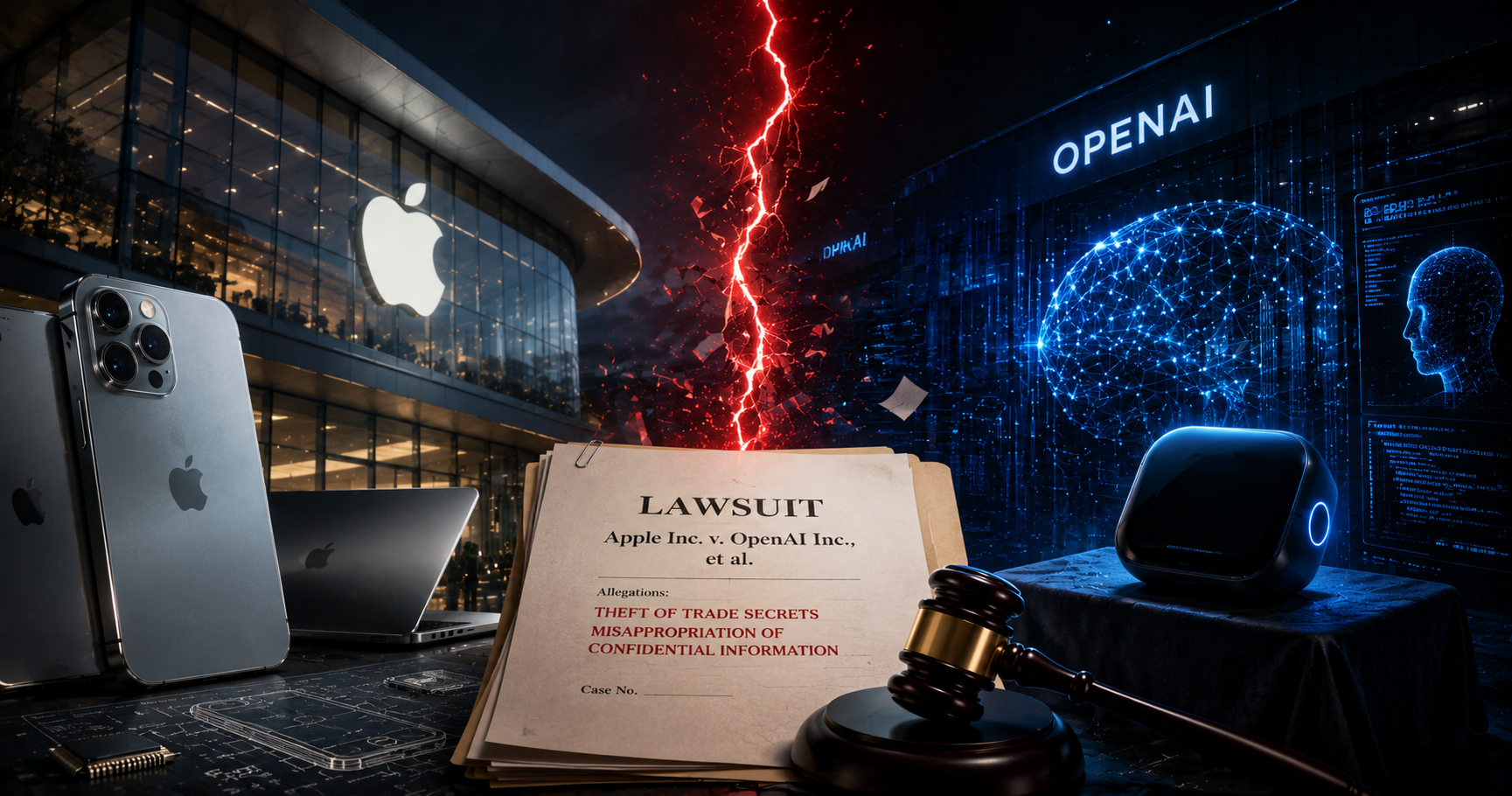
Apple has filed a lawsuit against OpenAI and two former Apple employees, accusing them of misappropriating confidential information connected to the iPhone maker's hardware technology.
The allegations arrive at a particularly sensitive moment.
OpenAI is expanding beyond ChatGPT and is widely expected to pursue consumer AI hardware.
Apple believes its secrets were used to help accelerate that effort.
OpenAI denies wrongdoing.
The case could become one of the most closely watched technology lawsuits of the AI era.
What Apple Is Accusing OpenAI of Doing
Apple's lawsuit alleges that OpenAI benefited from confidential information taken by former Apple employees.
The complaint names Tang Yew Tan and Chang Liu.
According to Apple's allegations, confidential hardware and supply-chain information was improperly accessed or transferred as OpenAI expanded its consumer hardware ambitions.
Apple describes the situation as more than an isolated disagreement with former workers.
The company alleges a wider pattern of misconduct.
These remain allegations presented in a lawsuit and have not been proven in court.
However, the details have immediately attracted attention across the technology industry.
The Case Involves More Than Ordinary Employee Poaching
Technology companies regularly recruit employees from competitors.
An engineer leaving one major company for another is not unusual.
Trade secrets are different.
Employees can generally use their professional skills and experience when moving jobs.
They cannot simply take protected confidential files, proprietary designs or other legally protected company information with them.
Apple's case is built around the allegation that this line was crossed.
Reuters reports that Apple claims former employee Chang Liu accessed its internal network and downloaded sensitive hardware files.
Apple also makes allegations involving Tang Tan's handling of confidential information and recruitment activity.
The court will ultimately have to assess the evidence behind those claims.
OpenAI's Secretive Hardware Plans Are Now Under a Microscope
OpenAI is best known for software.
ChatGPT transformed the company into one of the most recognisable names in artificial intelligence.
But the next stage of OpenAI's strategy may involve physical devices.
That possibility became even more significant after OpenAI's connection with legendary Apple designer Jony Ive and his hardware work.
The idea of an AI-first consumer device has generated enormous curiosity.
Could OpenAI create an alternative to the smartphone?
Could ChatGPT become the central interface of a new personal device?
Would users speak to an AI system instead of constantly opening apps?
Nobody outside the project has a complete public answer.
Apple's lawsuit may now bring even more attention to OpenAI's hardware ambitions.
Why Jony Ive's Connection Makes the Story Bigger
Jony Ive is one of the most influential product designers in modern technology.
His work at Apple was closely associated with products including the iPhone, iPod and Mac.
His involvement in AI hardware immediately raised expectations.
OpenAI's move into consumer devices is therefore not viewed as a small experimental project.
The company has access to major AI technology, significant investment and experienced hardware talent.
For Apple, the possibility of a powerful new AI device is strategically important.
The iPhone sits at the centre of Apple's consumer ecosystem.
Any technology that changes how people interact with digital services could eventually challenge the smartphone's position.
This legal dispute is therefore unfolding against a much larger competitive battle.
Apple Says Hundreds of Former Employees Work at OpenAI
One detail from the lawsuit demonstrates how intense the competition for AI talent has become.
Apple says more than 400 former Apple employees now work at OpenAI.
That number does not itself prove misconduct.
Employees regularly change companies, particularly in Silicon Valley.
Apple itself acknowledges that hiring former workers does not automatically give another company access to its trade secrets.
But the figure shows how aggressively technology companies are competing for experienced engineers and product specialists.
Artificial intelligence is creating one of the most intense talent wars in the history of the technology industry.
The people who understand advanced hardware, chips, interfaces and product design have become extremely valuable.
The ChatGPT and Apple Relationship Makes This Unusually Awkward
The dispute is particularly striking because Apple and OpenAI have worked together.
ChatGPT integration became part of Apple's wider artificial intelligence strategy.
Users could access ChatGPT capabilities through supported Apple experiences.
The partnership demonstrated how even major technology companies sometimes need to cooperate in the rapidly changing AI market.
The lawsuit now creates an uncomfortable situation.
Two companies can remain commercial partners while fighting in court.
But a serious trade-secret dispute can damage trust.
The future of the relationship may depend partly on how the case develops.
OpenAI Denies Apple's Allegations
OpenAI has rejected the accusation that it is interested in stealing other companies' trade secrets.
The company says it remains focused on innovation.
That distinction is important.
A lawsuit contains allegations from the party bringing the case.
It is not a final court judgment.
OpenAI will have the opportunity to challenge Apple's claims and present its own legal arguments.
The former employees named in the case will also face scrutiny over the specific conduct alleged by Apple.
Until evidence is tested through the legal process, readers should avoid treating disputed allegations as established facts.
What is already clear is that the relationship between the companies has entered a far more confrontational phase.
The AI Race Is Becoming a Hardware War
The first major generative AI battle was fought through chatbots.
OpenAI launched ChatGPT.
Google expanded Gemini.
Anthropic developed Claude.
Technology companies raced to build increasingly capable models.
The next battle is moving into physical infrastructure and consumer hardware.
Companies are designing AI chips.
Data centres are expanding.
Robotics investment is increasing.
Wearable AI devices are being tested.
New interfaces are being developed around voice, cameras and intelligent agents.
The company that controls the dominant AI device could gain an enormous strategic advantage.
Apple understands the power of controlling hardware and software together better than almost any technology company.
OpenAI appears increasingly interested in that same opportunity.
Could an OpenAI Device Actually Challenge the iPhone?
Replacing the smartphone is extremely difficult.
The iPhone is not simply a piece of hardware.
It is connected to an enormous ecosystem of applications, developers, accessories and services.
Many attempts to create new categories of personal devices have struggled to convince consumers to abandon their phones.
AI may create a new opportunity.
An intelligent device could potentially understand natural conversation, recognise the user's environment and complete tasks with fewer traditional apps.
Instead of navigating through menus, a user might simply describe what they want.
The technology is still evolving.
But if AI changes the primary way humans interact with computers, the companies leading that transition could reshape the consumer technology market.
This is why OpenAI's hardware plans matter.
The Lawsuit Could Reveal Details About a Mystery AI Device
Legal disputes sometimes expose information companies would prefer to keep private.
Court filings, evidence disputes and witness testimony can reveal details about internal projects.
That does not mean OpenAI's entire hardware roadmap will suddenly become public.
Companies can ask courts to protect sensitive information.
However, the case could still provide new clues about the scope of OpenAI's hardware operation.
Technology watchers will examine filings closely.
Hiring patterns, supply-chain relationships and internal project descriptions could become important parts of the dispute.
Ironically, Apple's attempt to protect confidential hardware information may increase public curiosity about OpenAI's secret device.
A Legal Battle With Much Bigger Consequences
Apple is seeking legal remedies over what it says was the improper use of confidential information.
OpenAI denies wrongdoing.
The court now has to deal with the facts and legal arguments.
But the wider significance of the dispute is already visible.
The AI race is no longer limited to who builds the smartest chatbot.
It is becoming a competition over engineers, chips, devices, supply chains and the future of personal computing.
Apple helped define the smartphone era.
OpenAI helped ignite the generative AI era.
Now the two companies are confronting each other as those worlds begin to collide.
And somewhere behind the lawsuit is a mysterious AI hardware project that could make this battle even bigger.