



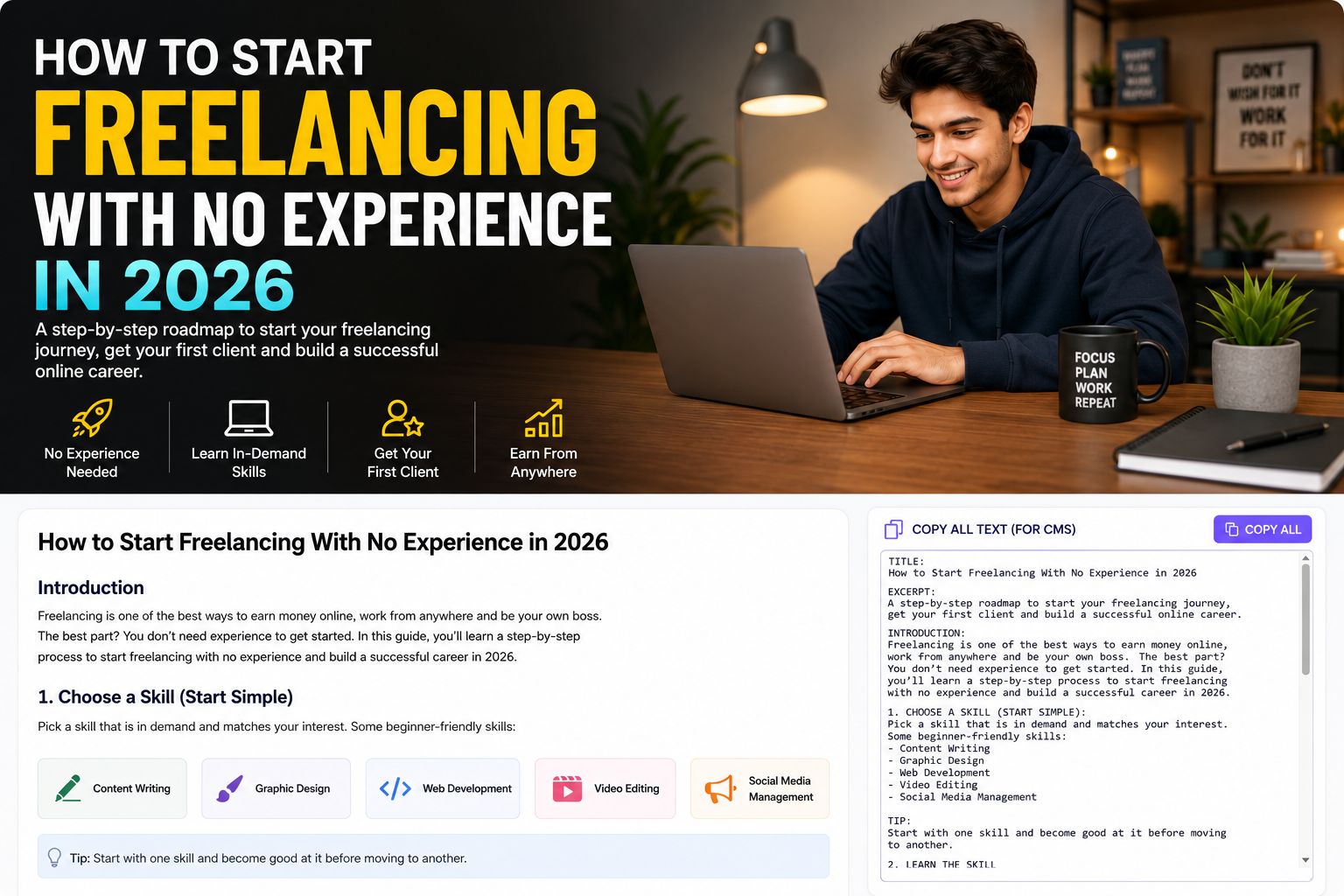
Starting freelancing with no experience can feel confusing, especially when you see other freelancers already earning, working with clients, and showing strong portfolios. But every successful freelancer started from zero at some point.
You do not need a traditional job, a long resume, or a big investment to begin freelancing. What you need is one useful skill, proof that you can do the work, and a simple plan to find your first client.
Freelancing in 2026 is competitive, but it is also full of opportunities. Businesses, creators, startups, agencies, and online stores need writers, designers, developers, video editors, virtual assistants, marketers, and customer support workers every day.
The real question is not whether freelancing works. The real question is whether you are willing to learn one skill properly and keep improving until clients trust you.
Can You Start Freelancing Without Experience?
Yes, you can start freelancing without experience. But you cannot start without skill.
Experience means you have already worked with clients. Skill means you can solve a problem. If you do not have client experience yet, you can still build skill through practice projects, sample work, mock projects, and small personal projects.
Clients usually care about three things:
Can you understand the task?
Can you deliver quality work?
Can you communicate professionally?
If your samples prove that you can do the work, you can start getting freelance opportunities even without previous client experience.
Step 1: Choose One Freelance Skill
The first step is choosing one skill. This is where many beginners make the biggest mistake. They try to learn writing, design, coding, video editing, SEO, AI tools, and marketing at the same time. That only creates confusion.
Choose one skill and focus on it for at least 30 to 60 days.
Beginner-friendly freelance skills include content writing, copywriting, Canva design, short video editing, virtual assistance, social media management, data entry, resume writing, presentation design, product description writing, email writing, and WordPress content upload.
High-income freelance skills include web development, mobile app development, SEO, UI/UX design, Shopify development, paid advertising, no-code automation, software QA testing, AI chatbot setup, data analysis, and technical writing.
If you want a simple start, choose content writing, Canva design, video editing, or virtual assistance. If you are technical, choose web development, QA testing, automation, or data analysis.
Step 2: Learn the Skill Properly
After choosing a skill, spend the first few weeks learning and practicing. Do not spend months only watching tutorials. Tutorials are useful, but practice is what builds confidence.
If you choose content writing, write five blog articles.
If you choose design, create ten social media posts.
If you choose video editing, edit five short videos.
If you choose web development, build three sample landing pages.
If you choose virtual assistance, create sample spreadsheets, email templates, and task boards.
Your goal is not to become perfect. Your goal is to become useful enough to solve a small client problem.
Step 3: Build a Portfolio Without Clients
A portfolio is your proof. If you have no experience, your portfolio becomes more important than your resume.
You can create a portfolio without real clients by making sample projects. These are practice projects that show what you can do.
A content writer can write SEO blog posts. A designer can create social media post samples. A video editor can edit sample Reels or Shorts. A web developer can build sample websites. A virtual assistant can create admin workflow samples. A social media manager can create a 30-day content calendar.
Put your portfolio on Google Drive, Notion, Behance, GitHub, LinkedIn, or a simple personal website.
Do not send clients a folder full of random files. Send three to five samples that match the exact service they need.
Step 4: Create a Fiverr Profile
Fiverr is one of the easiest freelancing platforms for beginners because you can create service listings called gigs. A buyer searches for a service, checks your gig, and places an order if your offer looks useful.
Your Fiverr profile should be focused and honest. It should include a professional profile picture, a clear title, a focused description, one main service, portfolio samples, simple English, and no fake claims.
Good Fiverr gig titles include:
“I will write SEO blog posts for your website.”
“I will design Canva social media posts.”
“I will edit short videos with captions.”
“I will create a WordPress landing page.”
“I will write product descriptions for your store.”
Do not write “I can do everything.” A focused gig is easier to understand and easier to sell.
Step 5: Create an Upwork Profile
Upwork is more competitive than Fiverr, but it can bring better long-term clients. On Upwork, freelancers usually apply to jobs by sending proposals.
Your Upwork profile should include a specific title, clear overview, relevant skills, portfolio samples, realistic rate, and strong first two lines.
A weak proposal says:
“I am expert freelancer. Please hire me.”
A strong proposal says:
“I saw you need five blog posts about fitness. I can write clear SEO-friendly articles and have attached two similar writing samples. I can also create the first outline before starting.”
The second proposal works better because it speaks directly to the client’s problem.
Step 6: Use LinkedIn to Find Clients
LinkedIn is one of the strongest platforms for freelancers because it is built around professional networking. Many clients, business owners, recruiters, founders, and agencies use LinkedIn every day.
Your LinkedIn profile should clearly explain what you do.
Example headlines:
Freelance Content Writer | SEO Blog Posts for Business Websites
Video Editor | Reels, Shorts, and YouTube Clips
WordPress Developer | Landing Pages and Business Websites
Virtual Assistant | Admin Support, Email, and Data Entry
Start posting your work. Share small case studies. Connect with business owners, creators, agencies, and startup founders. Send short messages that offer one clear service.
Do not spam people. Good outreach is specific, polite, and useful.
Step 7: Get Your First Client
Your first client can come from Fiverr, Upwork, LinkedIn, Facebook groups, Reddit communities, local businesses, personal referrals, or direct email outreach.
Your first client does not need to be a large company. A small business, creator, blogger, coach, real estate agent, restaurant, clinic, or local brand is enough.
A simple outreach message can be:
“Hi, I noticed your business page is active, but the captions could be more engaging. I can create a 15-day content plan with captions and post ideas. Here are two samples I made.”
Keep your message short. Show samples. Make the offer easy to understand.
Best Freelance Skills for Beginners in 2026
The best beginner skills are the ones that are easy to learn, easy to show in a portfolio, and easy for clients to understand.
The strongest beginner skills are short video editing, content writing, Canva design, social media captions, resume writing, virtual assistance, product descriptions, basic SEO writing, presentation design, and data entry.
The strongest long-term skills are web development, SEO strategy, paid ads, UI/UX design, automation, software testing, data analysis, AI chatbot setup, Shopify development, and technical writing.
A smart beginner can start with an easier skill and later move into a higher-income skill.
How to Price Your First Freelance Work
Beginners often make two pricing mistakes. Some charge too high without proof. Others charge too low and attract bad clients.
Your first goal is to get experience, reviews, confidence, and real communication practice. But that does not mean you should work for free forever.
Start with simple packages.
Examples:
5 social media captions
1 blog article
1 edited short video
1 landing page section
1 resume rewrite
1 product description batch
Small packages are easier for clients to buy and easier for you to deliver. After a few successful projects, increase your price slowly.
How to Build Trust Without Experience
Trust comes from clarity and proof.
You can build trust by showing portfolio samples, writing clear messages, replying professionally, delivering on time, explaining your process, being honest about your level, starting with smaller projects, asking for feedback, and improving after every project.
Do not pretend to be an expert if you are not. A client can accept a beginner if the beginner is honest, organized, and serious.
30-Day Beginner Roadmap
In the first three days, choose one skill and stop switching between different ideas.
From day four to day ten, learn the basics and practice daily.
From day eleven to day eighteen, create sample projects.
From day nineteen to day twenty-two, build your portfolio.
From day twenty-three to day twenty-five, create Fiverr, Upwork, and LinkedIn profiles.
From day twenty-six to day thirty, send proposals, message clients, post your work, and improve your offer.
This roadmap will not guarantee instant income, but it will give you a real start.
60-Day Growth Roadmap
In the first 15 days, learn one skill and practice daily.
From day 16 to day 30, build five to ten portfolio samples.
From day 31 to day 40, create profiles and publish your work.
From day 41 to day 50, send daily proposals and outreach messages.
From day 51 to day 60, improve your offer, follow up, and try to close small projects.
The goal is consistency. Freelancing rewards people who keep improving after rejection.
Common Mistakes Beginners Should Avoid
Many beginners fail because they repeat the same mistakes.
They learn too many skills at once.
They copy other freelancers’ profiles.
They send the same proposal to everyone.
They create profiles without portfolio samples.
They promise work they cannot deliver.
They use fake reviews or fake experience.
They quit after a few rejections.
They depend only on one platform.
They ignore communication skills.
They try to sell everything at once.
Most beginners do not fail because freelancing is impossible. They fail because they never focus long enough to become useful at one thing.
Best Tools for New Freelancers
Useful tools for beginners include Google Docs, Google Drive, Canva, CapCut, Notion, Grammarly, ChatGPT, Trello, Zoom, Loom, GitHub, and Behance.
These tools help you create work, organize projects, communicate with clients, and present your portfolio professionally.
Final Verdict
You can start freelancing with no experience in 2026 if you follow the right roadmap. You do not need client history to begin, but you do need skill, samples, and consistency.
Choose one skill. Practice it. Build a small portfolio. Create Fiverr, Upwork, and LinkedIn profiles. Start approaching clients with simple offers. Deliver quality work. Learn from every rejection.
Freelancing is not easy money, but it is a real career path. If you stay consistent, your first client can become the beginning of a long-term online income journey.